The Clock: When Each Row On This Panel Could Act
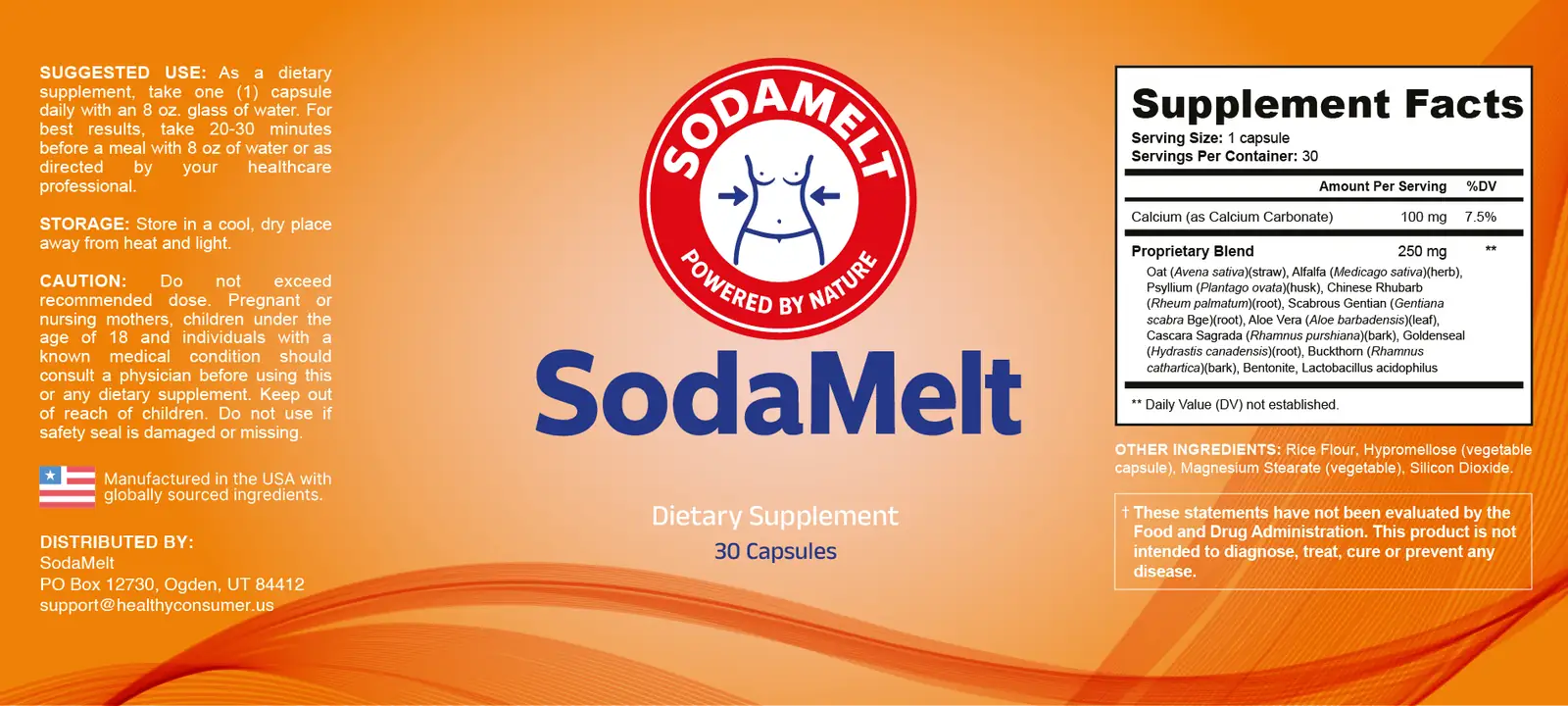
The label says to take one capsule 20 to 30 minutes before a meal. That is one moment in the day. The rows inside the capsule run on different clocks: minutes for the shell, hours for the calcium, most of a day for the stimulant botanicals, and days to weeks for psyllium and the live culture. This article puts each on its published time scale and lays them against a single daily capsule.
- One capsule contains rows that run on very different clocks. The shell opens in the stomach in minutes to hours. The calcium is handled over hours. The four stimulant-laxative botanicals need bacteria in the colon and, for a comparable cascara bark preparation, the EU herbal monograph puts the delay at 8 to 12 hours.
- Psyllium and the live culture are slower still. Psyllium’s trial effects on stool frequency showed up in week two of a two-week comparison, and a meta-analysis found improvement mostly at four weeks or more and above 10 g a day. Probiotic effects, where they appear, are measured over weeks and depend on the strain.
- Goldenseal’s clearest human finding, an effect on a drug-metabolising enzyme, was seen after 14 days of repeated dosing at gram-scale amounts.
- The label says to take the capsule 20 to 30 minutes before a meal. That is a timing for the shell and the calcium. It is not the timing of the anthranoid effect, and nothing on the retrieved timeline supports feeling a laxative effect within an hour or two of the capsule.
- The colon has a daily rhythm of its own. A bowel movement after waking or after eating is ordinary physiology, so timing alone cannot attribute it to a capsule.
One capsule, several stopwatches
Read the printed instruction first. The label says to take one capsule daily with an 8 oz glass of water and, for best results, 20 to 30 minutes before a meal. That is a single moment in the day. Nothing in it says how long anything inside the capsule needs to do what it is there to do, and the answer is different for every class of ingredient.
This article puts the classes on a timeline using what has been published about each: transit and disintegration studies, pharmacokinetic work, and the trials that report when an effect appeared. It does not use any product’s own claims, and it cannot say how this capsule behaves, since nobody has published that. What it can do is set out the time scale each class is known to work on, and lay those scales against a capsule taken before a meal.
| Row or class | What has to happen first | Time scale in the published work |
|---|---|---|
| Hypromellose shell | Open in the stomach so the contents are released | Minutes to hours, depending on what the capsule holds |
| Calcium (as calcium carbonate) | Dissolve in stomach acid, then be absorbed in the small intestine | Hours; a serum peak around four hours in one study of a different tablet |
| Four anthranoid botanicals (rhubarb, aloe leaf, cascara, buckthorn) | Travel unabsorbed to the colon, where bacteria release the active compound | About 8 to 12 hours for a cascara bark preparation, per the EU monograph |
| Psyllium husk | Swell in water, hold it in the stool, and do so day after day | Days in colon imaging at gram doses; weeks in symptom trials |
| Lactobacillus acidophilus | Survive passage, and possibly settle | Weeks in trials; a transient effect in the best human mucosal study |
| Goldenseal | Build up enough to inhibit a drug-metabolising enzyme | 14 days of repeated dosing in the human study on file |
Oat straw, alfalfa herb, scabrous gentian root and bentonite are not in the table. No published timing work was found for them in the forms the panel prints, and this article does not guess.
Minutes: the capsule opens
The first clock is the shell. The panel’s other-ingredients line names hypromellose as the vegetable capsule, and hypromellose capsules have been followed through the human gut with gamma scintigraphy. In one such study, the capsules tended to stick to the oesophagus, so the authors recommended taking them with 150 to 200 millilitres of water, upright, and staying upright for a few minutes (the scintigraphy study of hypromellose capsules). That is close to the 8 oz the label asks for, and it is the only time the water instruction comes up in this article.
The more useful finding is about opening. In the same study the capsules were filled with different grades of hypromellose powder as a prolonged-release model. Most of the capsules with the lower-viscosity fill had completely disintegrated within the eight-hour study, while those with the higher-viscosity fill still formed plugs in the large intestine. The lesson is that how fast a capsule opens and spreads depends on what is in it. It is not a fixed property of the shell. A blend of eleven botanicals, calcium carbonate, rice flour and silicon dioxide is a different fill from either of those, and no study of it exists.
What does seem robust is that the shell is not very sensitive to what is drunk with it. A 2025 study of 12 healthy volunteers found no significant differences in the opening time of hypromellose capsules in warm water, cold water or warm black tea, though gelatine capsules were slower in cold water (the 2025 capsule opening study). And food matters more than drink: when a different capsule design was tested in media containing milk and a liquid nutrition drink, disintegration slowed in the laboratory (the azithromycin capsule study). That study concerned an acid-sensitive antibiotic, and the effect it found on absorption was specific to that drug. None of the rows here is described that way. It is mentioned only because it shows why a capsule taken before a meal, in a less-full stomach, is not opening under the same conditions as one taken with food.
Hours: the calcium
The one row with a printed amount is calcium: 100 mg, or 7.5% of the daily value. Under the labeling rule, that figure is the weight of the calcium itself, not of the calcium carbonate it comes as (21 CFR 101.36 says the declared weight is “the weight of calcium rather than that of calcium carbonate”). Calcium carbonate has to dissolve to be absorbed, and a review of calcium absorption from foods points out that the low pH of the stomach is critical for solubilising and ionising calcium salts, and that the rate of gastric emptying can strongly affect how much is absorbed (the review of calcium absorption and the food matrix).
The classic study of carbonate and acid is worth knowing. In 1985, Recker compared calcium carbonate with a pH-adjusted citrate in 11 fasting patients with achlorhydria (no stomach acid) and 9 fasting normal subjects. In the normal subjects, fractional absorption from carbonate was 0.225 and from citrate 0.243, no significant difference. In the achlorhydric patients, absorption from carbonate was 0.042, against 0.452 from citrate. When the carbonate was given as part of a normal breakfast, absorption in the achlorhydric patients was completely normal (the 1985 achlorhydria study). The author noted that achlorhydria is common in older people.
What that means for a capsule taken before a meal is limited but clear. In someone with normal stomach acid, a carbonate taken on an empty stomach was absorbed about as well in that study as a citrate. The pre-meal timing matters chiefly for people whose stomachs make little acid. For scale, a fraction near 0.225 applied to 100 mg of calcium would be about 22 mg absorbed. That is a rough illustration with the numbers of a different-sized load, not a measurement of this capsule.
On timing, a single 2025 study of a different calcium carbonate tablet in healthy subjects is the nearest thing to a clock. Scintigraphy showed the tablet began to disintegrate within 15 minutes in the stomach and dispersed completely within four hours in the small intestine, and serum calcium peaked, with an increment of about 4 micrograms per millilitre, at four hours (the 2025 calcium carbonate absorption study). It is a single tablet, not a capsule, and not this product. But it gives the order of magnitude: hours, not minutes and not days.
Most of a day: the four anthranoid rows
The four names that matter most for effect run on the longest of the short clocks. The cascara article explains why: the active compounds are sugar-bound and are not split by human digestive enzymes, so they travel to the large intestine, where bacteria release the active form. A review of anthranoid metabolism describes the same route for the class, with the glycosides carried unabsorbed to the large intestine and the aglycon freed there by bacterial hydrolysis (de Witte and Lemli).
The EU herbal monograph for the bark turns that into hours. It says that defaecation takes place “after a delay of 8 - 12 hours due to the time taken for transport to the colon and metabolisation into the active compound,” and its dosing line says a preparation is to be taken once daily at night. Read the arithmetic plainly: a capsule taken at 7:30 in the morning puts the delay window at roughly 3:30 to 7:30 in the evening, and one taken before dinner puts it overnight. That is a statement about the monograph’s figure for a standardised bark preparation, not about this capsule and not advice about when to take it.
Individuals differ, and not by a little. A study of regional transit in 215 healthy volunteers with a wireless motility capsule found that testing protocol, sex, age and country all influenced transit times. Women had a longer colonic transit time by a median of 104 minutes and a longer whole-gut transit time by a median of 263 minutes than men, and whole-gut and colonic transit times clustered at values separated by 24 hours, so the authors argued they should not be described as continuous variables (the 215-volunteer transit study). A typical delay of 8 to 12 hours is a centre of gravity, not a schedule.
There is one more line worth reading. The panel’s last row is a live culture, and it is tempting to think a probiotic might speed the activation of the laxative botanicals, since it is bacteria that do the activating. A screen of 88 lactic acid bacterial strains and 47 bifidobacterial strains for the ability to hydrolyse sennosides, the prodrugs in senna, found that the four strong hydrolysers were all bifidobacteria, and one of them promoted peristalsis in mice (the sennoside hydrolysis screen). That is senna, not cascara, and mice, not people, and Lactobacillus acidophilus is not a bifidobacterium. It offers no support for the idea that the culture on this panel shortens the anthranoid clock, and no reason to think it lengthens it.
The colon keeps its own clock
This is the part of the timeline that changes how the rest should be read. The colon is not idle between laxative doses. A 2018 wireless-capsule study looked at what it calls the colonic wake response, a relative increase in colonic motility upon awakening, in healthy people and in patients with slow transit constipation, and found it blunted in the latter (the 2018 wake response study). A 2024 study of 387 outpatients opens with the statement that eating is the major synchroniser of gastrointestinal motility and secretions, and it measured a colonic transit response to eating (the 2024 response-to-eating study). A 2023 review sets out the circadian variation of colonic motility, absorption and secretion (the 2023 review of circadian rhythms in colonic function).
The reading for a capsule taken with water before a meal is direct. Waking and eating are themselves documented daily prompts to the colon. A bowel movement soon after them is what the colon ordinarily does. It cannot be pinned on a capsule by its timing, and it especially cannot be pinned on a mechanism whose published clock runs to 8 hours or more.
Days to weeks: psyllium
Psyllium works by holding water in the stool, and the evidence for its clock comes from two directions. In imaging studies, the effect shows after days. In a crossover study of nine adults without constipation and twenty with chronic constipation, six days of 7 g psyllium three times a day increased fasting colonic volume, from a median of 372 to 578 mL in the controls and from 831 to 1,104 mL in the patients, and increased small-bowel water after a meal (the six-day MRI study).
In symptom trials, the effect shows in weeks. In a two-week treatment comparison of 170 people with chronic idiopathic constipation, psyllium at 5.1 g twice daily raised stool water content and total stool output more than docusate did. Bowel movement frequency was significantly greater with psyllium in the second week (3.5 against 2.9 a week), while in the first week the groups did not differ significantly (3.3 against 3.1) (the 1998 psyllium against docusate trial). A meta-analysis of sixteen randomised trials found that fibre’s effect on stool frequency was apparent only with higher doses and durations of at least four weeks, and concluded that psyllium, doses above 10 g a day and at least four weeks appeared optimal (the 2022 fibre meta-analysis). One trial of twenty patients found that they responded clinically to fibre without a measured improvement in transit or contractility, a reminder that the mechanism is not simply speed (the 2024 transit time study).
Now the scale against this panel. Psyllium is the third name on the printed order, so it cannot exceed about 83 mg, one third of the 250 mg blend. The trials above used grams: 10.2 g a day in the docusate comparison and 21 g a day in the imaging study. On that arithmetic the row is under one percent of the amounts these results describe. The psyllium article works through that gap. The point for the clock is simpler: the published time scale for psyllium is days to weeks of gram-scale intake, and a milligram-scale share of a blend is not a reason to expect its clock to run faster.
Weeks, if at all: the live culture
The last row on the printed order is Lactobacillus acidophilus, with no count and no strain. Its clock is the hardest to state, because the evidence is about specific strains and the label names none.
A widely cited 2018 study sampled the human gut directly to see what happens to probiotic bacteria after they are swallowed. It found that an 11-strain probiotic combination stayed viable through the gut, but that colonisation of the mucosa was person-, region- and strain-specific and could not be told apart by whether the probiotic appeared in stool, and that the probiotics produced a transient, individualised effect on the mucosal community (the 2018 probiotic colonisation study). Transient is the operative word: an effect that does not persist is not a clock that starts and runs.
Where trials do report a benefit, it comes as an average over weeks of daily dosing and belongs to a named strain. A meta-analysis of 14 trials in functional constipation found probiotics reduced whole-gut transit time by 12.4 hours and increased stool frequency by 1.3 movements a week, with a significant effect for Bifidobacterium lactis and none for Lactobacillus casei Shirota, and it called for better data on species, dose and duration (the 2014 probiotics meta-analysis). A larger 2022 meta-analysis of 30 trials found the same pattern: Bifidobacterium lactis significant, mixtures not (the 2022 probiotics meta-analysis). Neither abstract reports a Lactobacillus acidophilus subgroup. The probiotic article covers survival and the missing count. For the clock, the fair statement is that any effect would be one of weeks and of a strain the label does not name.
Days of repeated dosing: goldenseal
Goldenseal is on the panel for reasons the label does not spell out, and its best-documented human finding is about other medicines. In a study of 16 healthy volunteers, 14 days of goldenseal supplementation raised the exposure of a test dose of midazolam from about 108 to about 175 ng·h/ml and lengthened its half-life from 2.0 to 3.2 hours, with a 30-day washout between phases, showing inhibition of the enzyme CYP3A (the 2008 goldenseal CYP3A study). A study of indinavir found no significant change after 14 days of 1,140 mg goldenseal root twice a day (the indinavir study).
Both were multi-week, multi-gram designs. Goldenseal is eighth on the printed order, so the row cannot exceed 31 mg, against 2,280 mg a day in the indinavir study. On that arithmetic it is about 1.4 percent of the intake that was studied. The goldenseal article takes up the interaction findings in full. For the clock, they say the enzyme effect is a feature of days of repeated dosing at large amounts, that it was reversed by a washout, and that nothing published describes it from a single 31 mg share of a blend.
The clocks on one line
Here is the same information laid against one capsule taken before breakfast. It uses only the time scales above, and every figure belongs to a different product, dose or study population.
| When | What the published work says could be happening |
|---|---|
| Minutes 0 to 30 | The shell opens in the stomach; the calcium salt starts to dissolve. A tablet study saw disintegration begin within 15 minutes. |
| Hours 1 to 4 | Calcium is absorbed; a serum peak near four hours was seen for a different tablet. |
| Hours 8 to 12 | For a comparable cascara bark preparation, the delay before the colonic effect begins. |
| Day 6 to 7 | At gram doses, psyllium changes colonic volume on MRI. Milligram shares are not comparable. |
| Week 2 and beyond | Psyllium’s frequency effect appeared in week two in one trial; a meta-analysis put the optimum at four weeks or more. |
| Weeks | Probiotic effects, where found, are averages over weeks of dosing and specific to a strain. |
| Day 14 | The point at which goldenseal’s enzyme effect was measured, at gram doses. |
None of these rows is a promise about this capsule. They are the time scales the studies found for the classes on the panel.
What to expect, and what not to
Three readings follow from the timeline, and they are about interpretation rather than about what to do.
- A movement within the first hour or two is unlikely to be the anthranoid mechanism. On the published timeline the botanicals that stimulate the bowel need the better part of a working day, and the colon’s own response to waking and eating is a documented alternative explanation for a movement soon after a capsule.
- The bulk-forming and live-culture clocks are measured in weeks, and neither can be judged from one day. The trials that show an effect use gram-scale psyllium and a named probiotic strain over a period of weeks. The row sizes on this panel are far below the first and unspecified for the second.
- The clocks do not add up to one. A bowel movement a day after starting could reflect the anthranoid rows, ordinary rhythm, a change in eating or drinking, or all three, and a single person’s experience cannot separate them. Repeated dosing over weeks makes the picture muddier, not clearer.
Anyone who is pregnant, nursing, under 18, taking prescription medicines or living with a medical condition should read the caution line row by row in its own article. Nothing here is a recommendation about timing or use.
What this article is not saying
It is not saying the capsule does or does not work, and it makes no claim about what any buyer will experience. The studies above used different products, doses and populations, and the intervals quoted are averages or single-study findings. And it is not saying a slow clock is a bad one. A stimulant laxative whose effect arrives in the evening is behaving as its chemistry says it should. What the timeline does is keep each row to its own stopwatch, so that an effect on one clock is not credited to a row on another.
References
- European Medicines Agency, Committee on Herbal Medicinal Products (HMPC). European Union herbal monograph on Rhamnus purshiana DC., cortex. Final, Revision 1. EMA/HMPC/726270/2016. 6 May 2020. https://www.ema.europa.eu/en/documents/herbal-monograph/final-european-union-herbal-monograph-rhamnus-purshiana-dc-cortex-revision-1_en.pdf
- European Medicines Agency, Committee on Herbal Medicinal Products (HMPC). Assessment report on Rhamnus purshiana DC., cortex. Final, Revision 1. EMA/HMPC/909434/2019. 6 May 2020. https://www.ema.europa.eu/en/documents/herbal-report/final-assessment-report-rhamnus-purshiana-dc-cortex-revision-1_en.pdf
- Honkanen O, Marvola J, Kanerva H, Lindevall K, Lipponen M, Kekki T, et al. Gamma scintigraphic evaluation of the fate of hydroxypropyl methylcellulose capsules in the human gastrointestinal tract. Eur J Pharm Sci. 2004;21(5):671-8. PMID 15066668. https://pubmed.ncbi.nlm.nih.gov/15066668/
- Sarwinska D, Leyh M, Foja C, Tzakri T, Schick P, Morof F, et al. The effect of black tea and water temperature on the disintegration of gelatine and HPMC capsules, tested with the paddle device, GastroDuo and in vivo pharmacokinetics: Much ado about little. Int J Pharm X. 2025;9:100342. PMID 40521162. https://pubmed.ncbi.nlm.nih.gov/40521162/
- Curatolo W, Liu P, Johnson BA, Hausberger A, Quan E, Vendola T, et al. Effects of food on a gastrically degraded drug: azithromycin fast-dissolving gelatin capsules and HPMC capsules. Pharm Res. 2011;28(7):1531-9. PMID 21331473. https://pubmed.ncbi.nlm.nih.gov/21331473/
- Shkembi B, Huppertz T. Calcium Absorption from Food Products: Food Matrix Effects. Nutrients. 2021;14(1):180. PMID 35011055. https://pubmed.ncbi.nlm.nih.gov/35011055/
- Recker RR. Calcium absorption and achlorhydria. N Engl J Med. 1985;313(2):70-3. PMID 4000241. https://pubmed.ncbi.nlm.nih.gov/4000241/
- Jain GK, Hasan N, Chandra N, Mishra A. Absorption, Scintigraphy, Efficacy and Tolerability of Short-Term Calcium Carbonate Supplementation in Healthy Subjects. Cureus. 2025;17(7):e87642. PMID 40786390. https://pubmed.ncbi.nlm.nih.gov/40786390/
- de Witte P, Lemli L. The metabolism of anthranoid laxatives. Hepatogastroenterology. 1990;37(6):601-5. PMID 2289777. https://pubmed.ncbi.nlm.nih.gov/2289777/
- Dreessen M, Lemli J. Studies in the field of drugs containing anthraquinone derivatives. XXXVI. The metabolism of cascarosides by intestinal bacteria. Pharm Acta Helv. 1988;63(9-10):287-9. PMID 3237734. https://pubmed.ncbi.nlm.nih.gov/3237734/
- Wang YT, Mohammed SD, Farmer AD, Wang D, Zarate N, Hobson AR, et al. Regional gastrointestinal transit and pH studied in 215 healthy volunteers using the wireless motility capsule: influence of age, gender, study country and testing protocol. Aliment Pharmacol Ther. 2015;42(6):761-72. PMID 26223837. https://pubmed.ncbi.nlm.nih.gov/26223837/
- Matsumoto M, Ishige A, Yazawa Y, Kondo M, Muramatsu K, Watanabe K. Promotion of intestinal peristalsis by Bifidobacterium spp. capable of hydrolysing sennosides in mice. PLoS One. 2012;7(2):e31700. PMID 22384059. https://pubmed.ncbi.nlm.nih.gov/22384059/
- Surjanhata B, Barshop K, Staller K, Semler J, Guay L, Kuo B. Colonic motor response to wakening is blunted in slow transit constipation as detected by wireless motility capsule. Clin Transl Gastroenterol. 2018;9(4):144. PMID 29691377. https://pubmed.ncbi.nlm.nih.gov/29691377/
- Deutsch D, Bouchoucha M, Uzan J, Airinei G, Sabate JM, Benamouzig R. Relationship Between Colonic Transit Response to Eating With Self-reported Constipation Severity in Constipated Patients According to the Phenotype. J Neurogastroenterol Motil. 2024;30(1):97-105. PMID 38173161. https://pubmed.ncbi.nlm.nih.gov/38173161/
- Hibberd TJ, Ramsay S, Spencer-Merris P, Dinning PG, Zagorodnyuk VP, Spencer NJ. Circadian rhythms in colonic function. Front Physiol. 2023;14:1239278. PMID 37711458. https://pubmed.ncbi.nlm.nih.gov/37711458/
- Major G, Murray K, Singh G, Nowak A, Hoad CL, Marciani L, et al. Demonstration of differences in colonic volumes, transit, chyme consistency, and response to psyllium between healthy and constipated subjects using magnetic resonance imaging. Neurogastroenterol Motil. 2018;30(9):e13400. PMID 30062794. https://pubmed.ncbi.nlm.nih.gov/30062794/
- McRorie JW, Daggy BP, Morel JG, Diersing PS, Miner PB, Robinson M. Psyllium is superior to docusate sodium for treatment of chronic constipation. Aliment Pharmacol Ther. 1998;12(5):491-7. PMID 9663731. https://pubmed.ncbi.nlm.nih.gov/9663731/
- van der Schoot A, Drysdale C, Whelan K, Dimidi E. The Effect of Fiber Supplementation on Chronic Constipation in Adults: An Updated Systematic Review and Meta-Analysis of Randomized Controlled Trials. Am J Clin Nutr. 2022;116(4):953-969. PMID 35816465. https://pubmed.ncbi.nlm.nih.gov/35816465/
- Coss-Adame E, Arenas-Martínez JS, García-Cedillo MF, Nosthas LC, Bustillo-Armendriz G. The effect of fiber supplementation with agave fructans or psyllium plantago in symptoms of constipation and its relation with whole and regional transit time and pH. Neurogastroenterol Motil. 2024;36(11):e14908. PMID 39223790. https://pubmed.ncbi.nlm.nih.gov/39223790/
- Zmora N, Zilberman-Schapira G, Suez J, Mor U, Dori-Bachash M, Bashiardes S, et al. Personalized Gut Mucosal Colonization Resistance to Empiric Probiotics Is Associated with Unique Host and Microbiome Features. Cell. 2018;174(6):1388-1405.e21. PMID 30193112. https://pubmed.ncbi.nlm.nih.gov/30193112/
- Dimidi E, Christodoulides S, Fragkos KC, Scott SM, Whelan K. The effect of probiotics on functional constipation in adults: a systematic review and meta-analysis of randomized controlled trials. Am J Clin Nutr. 2014;100(4):1075-84. PMID 25099542. https://pubmed.ncbi.nlm.nih.gov/25099542/
- van der Schoot A, Helander C, Whelan K, Dimidi E. Probiotics and synbiotics in chronic constipation in adults: A systematic review and meta-analysis of randomized controlled trials. Clin Nutr. 2022;41(12):2759-2777. PMID 36372047. https://pubmed.ncbi.nlm.nih.gov/36372047/
- Gurley BJ, Swain A, Hubbard MA, Hartsfield F, Thaden J, Williams DK, et al. Supplementation with goldenseal (Hydrastis canadensis), but not kava kava (Piper methysticum), inhibits human CYP3A activity in vivo. Clin Pharmacol Ther. 2008;83(1):61-9. PMID 17495878. https://pubmed.ncbi.nlm.nih.gov/17495878/
- Sandhu RS, Prescilla RP, Simonelli TM, Edwards DJ. Influence of goldenseal root on the pharmacokinetics of indinavir. J Clin Pharmacol. 2003;43(11):1283-8. PMID 14551183. https://pubmed.ncbi.nlm.nih.gov/14551183/
- Nutrition labeling of dietary supplements (21 CFR 101.36). 21 CFR 101.36. Electronic Code of Federal Regulations, current as of 24 September 2026, read 27 September 2026. https://www.ecfr.gov/current/title-21/section-101.36