SodaMelt Official Website › Blog › Lactobacillus Without A Coating
Lactobacillus Acidophilus, No Coating: Does It Reach The Gut Alive?
Last by weight on this panel is a live culture, Lactobacillus acidophilus, with no colony count, no strain code and no mention of a delivery technology. A probiotic only does anything if enough of it survives stomach acid to reach the intestine alive. Here is what the packaging science says decides that, and what this label leaves unanswered.
- A probiotic capsule’s job has two stages: the organism has to survive manufacturing and storage, then survive stomach acid on the way down. Both stages cause real, measured die-off.
- Enteric coatings and multilayer encapsulation are the standard tools formulators use to protect a culture through the stomach; published comparisons show they meaningfully change how much survives.
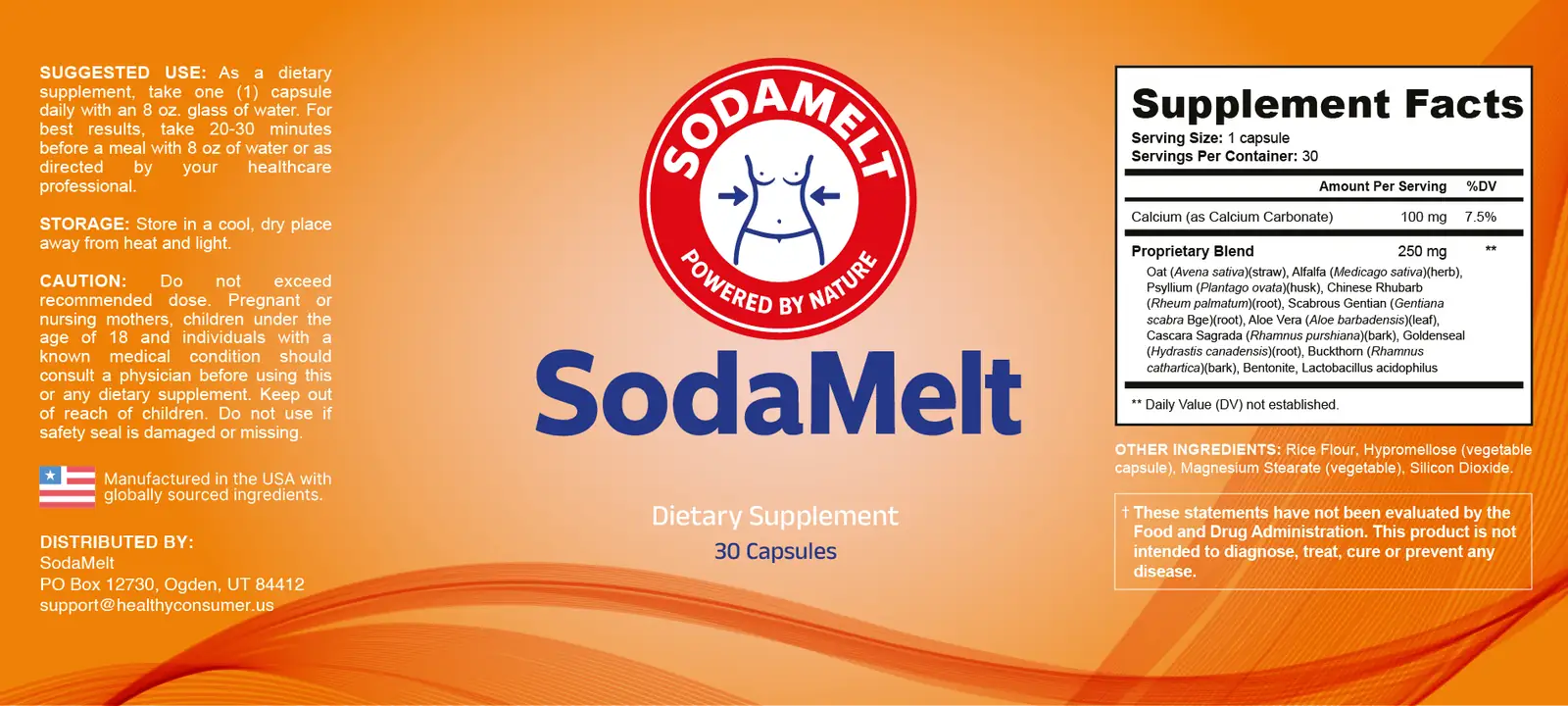
- The capsule shell on this label is hypromellose, described on the panel as the vegetable capsule material, with no enteric coating or delivery technology named.
- Because no colony-forming-unit count is printed at all, the question of how many organisms survive is secondary to a more basic one: how many were in the capsule to begin with.
- None of this means the culture does nothing. It means the label does not give a reader the information a probiotic trial would normally require to be assessed.
The two survival stages a probiotic has to clear
A live-culture ingredient is unlike every botanical on this panel in one specific way: it can die before you ever swallow it, and it can die again after you do. Both failure points are studied separately in the probiotics literature, and both are relevant to a shelf-stable capsule like this one.
The first stage is processing and storage. Freeze-drying, filling and months on a shelf or in a warehouse all reduce the number of live organisms in a dose, and the rate of that decline depends on the strain, the protectant used during drying, and the storage temperature. The second stage is gastrointestinal transit: stomach acid is a harsh environment for most bacteria, and an organism that survived the first stage perfectly can still be substantially reduced by the trip through the stomach.
What an enteric coating actually changes
An enteric coating is a polymer layer applied to a capsule that resists dissolving in stomach acid and dissolves instead in the more neutral environment of the small intestine, timing the release of its contents to skip the harshest part of the journey. It is a standard tool in probiotic formulation specifically because it addresses the second survival stage directly.
A 2024 study using freeze-dried Lactobacillus acidophilus LA-5, a specific commercial strain, tested the culture both freeze-dried and stored, and then filled into hard capsules that were enteric coated using a pharmaceutical co-polymer. The freeze-drying and storage steps did not cause significant viability loss when the right protectants were used, and the enteric-coated capsules were then tested for resistance to simulated gastric conditions (Fredua-Agyeman, 2024). The point of that study design is the point worth taking away here: viability through processing and viability through the stomach are separable problems, and a coating is specifically aimed at the second one.
A separate 2025 comparison went further, testing Lactobacillus acidophilus and Bifidobacterium animalis subsp. lactis in both encapsulated and free (uncoated) forms against an in vitro digestion model simulating gastric and intestinal conditions. The encapsulated probiotics, formulated with a multilayer protective matrix, showed significantly higher viability through the simulated digestion than the free, unprotected forms (Kim et al., 2025). That is a direct, controlled demonstration that coating status changes survival outcomes for this exact species.
See exactly what the SodaMelt panel prints
Two rows, eleven names inside one of them, including the one row with a species name and nothing else.
One bottle $89 · six bottles $294 · 60-day money-back guarantee
Order SodaMelt On The Official WebsiteOne capsule a day · 30 per bottle · lot SOD-26/GO-2953
What survives when there is no coating
Neither study above found that an uncoated or unprotected culture survives at zero — some organisms reach the intestine either way, because stomach transit time and acid exposure vary from one meal and one person to the next, and some Lactobacillus strains are naturally more acid-tolerant than others. What both studies show is a difference in degree: the protected, coated forms consistently did better than the free forms tested alongside them in the same experiment.
That is the honest, illustrative shape of the finding: an uncoated capsule is not a guaranteed failure, and a coated one is not a guaranteed success. What the research supports is that coating status is one of the variables that predictably moves the outcome, which makes it worth knowing whether a given product has one.
What this label's capsule shell tells you, and what it doesn't
The supplement facts panel on this bottle lists the capsule shell itself, under other ingredients, as hypromellose — described on the label as the vegetable capsule material. Hypromellose is a common, non-gelatin capsule shell material. It is not, by itself, an enteric coating; enteric coatings are typically a separate polymer layer such as the co-polymer used in the freeze-drying study above, applied on top of or instead of a standard shell, and formulated specifically to resist gastric acid.
Nothing on this label names an enteric coating, a delayed-release technology, or any other acid-protection method for the capsule contents. That is not the same as proof that none exists — a coating could be present without the word appearing on a consumer-facing panel, though it is the kind of feature manufacturers usually highlight when they have paid for it. What can be said plainly is that the label does not claim one, and this website has no way to confirm one from the outside.
Why a species name isn't a strain name
Lactobacillus acidophilus is a species, and a species covers many distinct strains that can behave quite differently from each other. Both studies cited above make this concrete simply by how they identify their organism: the freeze-drying study used a specific named commercial strain, LA-5, not just “Lactobacillus acidophilus” in general (Fredua-Agyeman, 2024). Probiotic research is generally strain-specific for exactly this reason: acid tolerance, bile tolerance, adhesion and clinical effects have all been shown to vary meaningfully between strains carrying the same species name.
This label prints the species name only, with no strain designation. That is a common practice across the supplement category, not something unique to this product, but it means a reader cannot look up strain-specific survival or efficacy data the way the studies above allow for LA-5 specifically. The species name confirms what kind of organism is present; it does not confirm which published research, if any, was performed on that particular strain.
Why the missing count matters more than the coating question
A colony-forming-unit count is the standard unit probiotic trials use to dose their intervention and to report their results, typically in the billions of CFU per serving. This label prints none. That omission sits upstream of the coating question: even a perfectly protected capsule delivering one hundred percent of its contents intact is only meaningful if the starting count was large enough to matter, and a reader has no way to check that starting count here at all.
Put plainly, this ingredient has two separate unknowns stacked on top of each other: how many organisms were in the capsule to start, and what fraction of them plausibly survive to the intestine. This page can speak to the second question in general terms, using published research on the species. It cannot speak to the first at all, because the label supplies no number to reason from.
What a stronger probiotic label would print
None of the following is exotic or expensive to disclose; every probiotic product that publishes it is choosing to, not solving a technical problem nothing else can solve.
- A CFU count at time of manufacture, and ideally a second guaranteed count through the end of shelf life, since viability declines with storage.
- A strain designation, not just a species name, so a buyer can look up whether that exact strain has been studied for anything specific.
- Whether the capsule uses an enteric coating, a delayed-release technology, or neither, so survival through the stomach is not left to inference from a generic capsule-shell ingredient line.
- Storage instructions specific to the strain used, since some require refrigeration to maintain viability and others are shelf-stable at room temperature by design.
This label supplies none of the four. That does not mean the culture is inactive; it means a reader who wants to verify viability has to ask the seller directly rather than read it off the panel, which is true of very few other rows on this bottle.
What a reader can still do with this
- Do not assume “probiotic” on an ingredient list means a clinically meaningful dose arrived intact. Both the count and the delivery method are open questions on this label, and neither can be settled by reading the panel a second time.
- If a delivery technology or CFU count matters to you, that is a fair, specific question to put to the seller’s support desk before ordering — and a specific enough question that a vague answer is itself informative.
- Treat this ingredient as the least verifiable row on an already hard-to-verify panel: it sits inside a proprietary blend with no per-ingredient weight, and unlike the botanicals around it, it also carries no dose unit this label uses at all.
- Remember that this row is last by weight in the blend, which independently caps how much material of any kind, live culture included, this capsule can contain at that position.
None of this is a reason to assume the worst about the ingredient. Live-culture rows are routinely under-specified across the supplement category, not just on this bottle, and a species name with no further detail is closer to the industry norm than an outlier. The point of setting out the survival science above is narrower: it gives a reader a framework for what questions a fuller label would answer, rather than leaving “probiotic” to function as a single unexamined word on an ingredient list.
References
- Fredua-Agyeman M. Surviving process and transit: Controlled freeze drying, storage and enteric coated capsules for targeted delivery of probiotic Lactobacillus acidophilus. Heliyon. 2024;10(7):e28407. PMID 38560212. https://pubmed.ncbi.nlm.nih.gov/38560212/
- Kim G, Seong H, Han SH, et al. Gastrointestinal Tolerance and Gut Microbiota Modulation of Encapsulated and Free Forms of Lactobacillus acidophilus and Bifidobacterium animalis subsp. lactis. J Microbiol Biotechnol. 2025;35:e2506028. PMID 41016814. https://pubmed.ncbi.nlm.nih.gov/41016814/