SodaMelt Official Website › Supplement facts
Supplement factsSodaMelt Supplement Facts
The SodaMelt panel prints two rows on a serving of one capsule.
Calcium as calcium carbonate carries 100 mg at 7.5% of a Daily Value. A 250 mg Proprietary Blend carries 11 botanicals under one shared figure, with a footnote reading Daily Value not established. Thirty servings to a bottle.
The panel as printed, the arithmetic around it, and what the blend row does and does not settle.
What is on the SodaMelt Supplement Facts panel?
Two rows, one footnote, and a block of eleven names underneath.
| Row | Amount per serving | % Daily Value |
|---|---|---|
| Calcium (as Calcium Carbonate) | 100 mg | 7.5% |
| Proprietary Blend | 250 mg | † |
Serving size one capsule. Servings per container 30. The dagger is the panel's own footnote and reads “Daily Value (DV) not established”.
A Supplement Facts panel has a fixed grammar. Each row carries a name, an amount per serving and a percentage of a Daily Value where one exists. Ingredients with no established Daily Value take a symbol and a footnote instead, which is what the dagger on the second row is doing.
Underneath the blend row the artwork prints the 11 botanical names in a block of continuous type. Typographically they belong to the blend line above them, which is exactly what the format intends: they are the contents of one row rather than rows of their own.
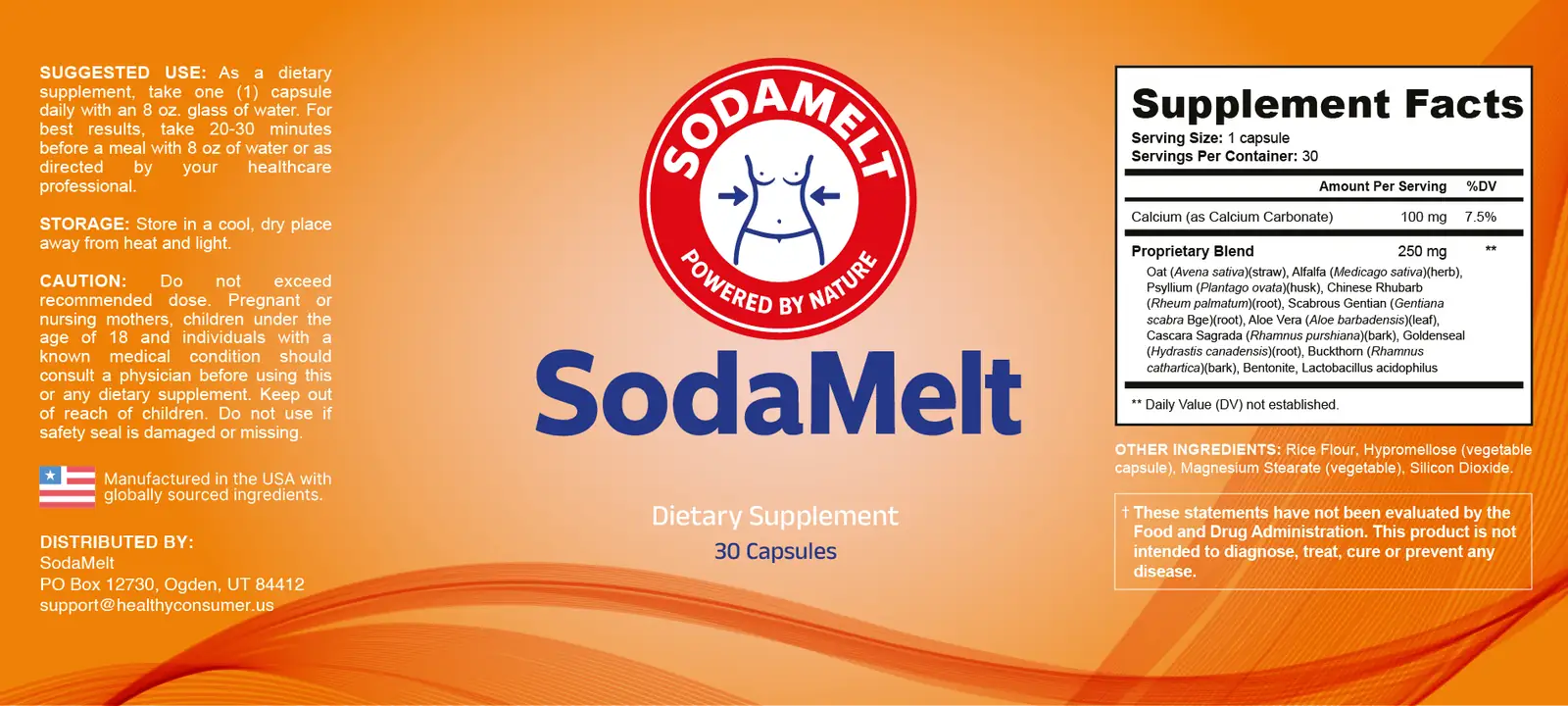
The panel as it appears on the bottle, at a size where the footnote and the botanical block can both be read. Everything on this page is taken from this image rather than from a seller's summary of it.
Two figures appear nowhere else on the bottle: the 7.5 per cent beside calcium, and the 250 mg beside the blend. Both are worth more attention than they usually get.
How the SodaMelt serving size turns into a bottle
Four printed figures, and what they add up to over a bottle.
| Figure | Value | Where it comes from |
|---|---|---|
| Serving size | 1 capsule | Printed at the head of the panel |
| Servings per container | 30 | Printed beside it |
| Capsules in a bottle | 30 | The same figure, since one capsule is one serving |
| Days a bottle lasts | 30 | At the label dose of one capsule daily |
| Calcium across a bottle | 3,000 mg | 100 mg a serving over 30 servings |
| Blend across a bottle | 7,500 mg | 250 mg a serving over 30 servings |
| Blend across the whole guarantee window | 15,000 mg | Two bottles, which is what 60 days allows |
Every figure here is arithmetic on the two printed numbers. Nothing is estimated.
One capsule, one serving and one day all being the same thing is a convenience worth noticing. A bottle is a month. Two bottles is the realistic trial window, and it finishes inside the 60-day guarantee with time to post a return.
The bottom rows are there for scale. Seven and a half grams of blend across a whole month sounds larger than 250 mg a day, and it is still less than a single day of the psyllium amount the constipation trials ran at. Spreading a figure across thirty days makes it look bigger without making it bigger.
What the SodaMelt calcium row tells you
The only row on this panel where two numbers can be set against each other.
Calcium at 100 mg with 7.5% beside it is the only place on this bottle where two numbers can be checked against each other. A percentage of a Daily Value is the amount divided by the reference intake, so the panel's own figures imply a reference near 1,333 mg.
That is the arithmetic the panel itself sets up, and it is worth doing once because it is the only row on this label that permits it. Everything else on the panel sits behind a blend total.
| What the panel gives | The arithmetic | What it means |
|---|---|---|
| 100 mg calcium | The elemental mineral, not the salt | Calcium carbonate is roughly 40 per cent calcium by weight, so this comes from about 250 mg of carbonate |
| 7.5% of a Daily Value | 100 divided by the reference intake | Implies a reference near 1,333 mg, which is the panel's own arithmetic |
| One serving a day | 100 mg daily | A small share of an adult intake, which the percentage says plainly |
| Carbonate as the form | Needs stomach acid to dissolve | The absorption study gave it with food; the label asks for it before a meal |
Four readings of one row, which is as much as a single panel line will support.
Why calcium carbonate is in a digestion blend at all is a fair question. It is the antacid mineral, and at a few hundred milligrams a tablet it neutralises stomach acid. At 100 mg of elemental calcium it is a nutritional line rather than a neutralising one, and the 2025 short-term absorption work is about uptake rather than about digestive comfort.
The one practical note is the timing. Carbonate dissolves best in an acid stomach, which is why absorption studies give it with food, and the label asks for the capsule 20 to 30 minutes before a meal. The two pull gently in opposite directions and the label is what this site follows.
What the SodaMelt proprietary blend row covers
Eleven names, one figure, and what that format does and does not hide.
| # | Name as printed | Latin name and plant part |
|---|---|---|
| 1 | Oat | Avena sativa, straw |
| 2 | Alfalfa | Medicago sativa, herb |
| 3 | Psyllium | Plantago ovata, husk |
| 4 | Chinese Rhubarb | Rheum palmatum, root |
| 5 | Scabrous Gentian | Gentiana scabra Bge, root |
| 6 | Aloe Vera | Aloe barbadensis, leaf |
| 7 | Cascara Sagrada | Rhamnus purshiana, bark |
| 8 | Goldenseal | Hydrastis canadensis, root |
| 9 | Buckthorn | Rhamnus cathartica, bark |
| 10 | Bentonite | no botanical source printed on the panel |
| 11 | Lactobacillus acidophilus | no botanical source printed on the panel |
All 11 of these sit inside the single 250 mg line above.
A proprietary blend is a legal format rather than a loophole. It lets a manufacturer declare a total and keep the recipe, which protects a formulation from being copied off the back of the bottle. An NIH perspective on the format sets out what is traded away in return.
What a reader gets is a ceiling. No single name in that list exceeds 250 mg, because that is the whole line. Divided evenly it would be about 22.7 mg each, and real blends are weighted rather than even, so any particular ingredient sits somewhere between a trace and the ceiling.
“Daily Value (DV) not established” means no reference intake exists for the blend, which is true of botanicals generally. It is a statement about regulation rather than about quality, and it applies to the row rather than to any one plant in it.
The practical consequence runs through the whole site. The ingredients page sets the blend total against the amount each trial used, and the same pattern appears eleven times: the research ran in grams or in colony-forming units, and the panel answers in one shared figure. That repetition is the finding rather than a complaint.
The SodaMelt other ingredients line
What holds the capsule together, and what the shell is made of.
| Inactive ingredient | Function | Worth knowing |
|---|---|---|
| Rice Flour | Bulking agent | Brings a small quantity of powder up to capsule volume |
| Hypromellose | The capsule shell | A plant cellulose, so the capsule carries no gelatin |
| Magnesium Stearate (vegetable) | Flow agent | Keeps powder metering evenly into shells; the vegetable grade is specified |
| Silicon Dioxide | Anti-caking agent | Keeps the powder dry and free-running in the bottle |
Printed under Other Ingredients on the artwork, in this order.
Four inactives, all ordinary, and the shell is the one that answers a real question. Hypromellose is made from plant cellulose, so this capsule suits a vegetarian diet. The artwork makes no vegan, kosher or halal claim and carries no allergen statement.
Rice flour is worth a second look only because of what it implies about volume. A capsule that needs a bulking agent is not full of active material, and 100 mg of calcium plus 250 mg of blend is 350 mg of declared content in a shell that typically holds rather more.
Everything else printed on the SodaMelt bottle
Six printed blocks that are not the panel.
Suggested use
Take one (1) capsule daily with an 8 oz glass of water. For best results, take 20–30 minutes before a meal with 8 oz of water or as directed by your healthcare professional.
Storage
Store in a cool, dry place away from heat and light. A live culture and a clay both respond badly to warmth and damp, so this line is more than boilerplate here.
Caution
Do not exceed recommended dose. Pregnant or nursing mothers, children under the age of 18 and individuals with a known medical condition should consult a physician before using this or any dietary supplement. Keep out of reach of children. Do not use if safety seal is damaged or missing.
Sourcing
Manufactured in the USA with globally sourced ingredients. A sourcing statement, not a certification, and it says plainly that the ingredients come from more than one country.
Distributed by
SodaMelt, PO Box 12730, Ogden, UT 84412, with [email protected] printed beside it. That address is the distributor's and does not accept returns; returns go to 395 Hudson Street, Suite 401, New York, NY 10014, USA.
The federal statement
These statements have not been evaluated by the Food and Drug Administration. This product is not intended to diagnose, treat, cure or prevent any disease.
Read as a whole, the artwork is notable for what it says about the product rather than for what it claims. The bottle carries the name, the panel, the instructions, the caution, the sourcing line, a roundel reading “Powered by Nature” and the federal disclaimer.
The three supports this website names come from the seller's own page rather than from the label, and the benefits page takes each of them apart. The bottle itself makes no structure or function claim at all.
Where the SodaMelt graphic and the SodaMelt panel disagree
Two pictures of the same capsule, carrying two different lists.
The seller's ingredients graphic illustrates seven botanicals and prints SELECTED FORMULA INGREDIENTS at its foot. The printed panel lists eleven. Four names appear on the bottle and not in the picture: Scabrous Gentian, Goldenseal, Buckthorn and Bentonite.
Two of those four are anthranoid stimulant laxatives. The graphic's own footnote is accurate and the difference is easy to miss, which is why it is stated here once, in the section whose job it is, rather than mentioned on every page.
| Name | On the printed panel | In the seller's graphic | Type of ingredient |
|---|---|---|---|
| Oat | yes | yes | other |
| Alfalfa | yes | yes | other |
| Psyllium | yes | yes | other |
| Chinese Rhubarb | yes | yes | anthranoid stimulant |
| Scabrous Gentian | yes | no | other |
| Aloe Vera | yes | yes | anthranoid stimulant |
| Cascara Sagrada | yes | yes | anthranoid stimulant |
| Goldenseal | yes | no | other |
| Buckthorn | yes | no | anthranoid stimulant |
| Bentonite | yes | no | other |
| Lactobacillus acidophilus | yes | yes | other |
The panel governs. Where a graphic and a printed panel differ, the bottle is what arrives in the box.
There is a second, quieter difference. The seller's own information page opens with sodium bicarbonate, natron and the history of the digestive biscuit, and no sodium bicarbonate appears anywhere on this panel or in the inactive line. The name of the product follows the story rather than the formula.
SodaMelt label questions
How many rows does the SodaMelt panel have?
Two. Calcium as calcium carbonate at 100 mg with 7.5 per cent of a Daily Value, and a 250 mg Proprietary Blend carrying 11 botanical names underneath it.
What does the dagger on the SodaMelt panel mean?
It points at the panel's own footnote, which reads “Daily Value (DV) not established”. That is standard for botanicals, since no reference intake exists for them, and it applies to the blend row rather than to any single plant.
How much psyllium is in SodaMelt?
The panel gives one figure for the whole blend, so the answer is somewhere between a trace and 250 mg. An even split across 11 names would be about 22.7 mg, and the trials behind psyllium's reputation ran at 10 g a day.
Does the SodaMelt capsule contain gelatin?
No. The shell is hypromellose, a plant cellulose, and the magnesium stearate is the vegetable grade. There is no gelatin in the capsule.
Is there sodium bicarbonate in SodaMelt?
None appears on the Supplement Facts panel or the other ingredients line. The name comes from the seller's origin story rather than from a row on the label.
Can I see the SodaMelt certificate of analysis?
The certificate reference the order desk carries is SOD-2953-26-GO and the bottle carries lot SOD-26/GO-2953. The batch verification page sets out what each reference covers and how to ask for it.
Sources for the SodaMelt panel analysis
The published work behind the calcium arithmetic and the blend format.
- Jain GK, Hasan N, Chandra N, et al. Absorption, Scintigraphy, Efficacy and Tolerability of Short-Term Calcium Carbonate Supplementation in Healthy Subjects. Cureus. 2025;17(7):e87642. PMID 40786390. https://pubmed.ncbi.nlm.nih.gov/40786390/
- Saldanha LG, Dwyer JT, Hardy CJ, et al. Perspectives on the Use of Proprietary Blends in Dietary Supplements. J Nutr. 2023;153(5):1305-1308. PMID 37004873. https://pubmed.ncbi.nlm.nih.gov/37004873/
- Turck D, Bohn T, Castenmiller J, et al. Scientific Opinion on additional scientific data related to the safety of preparations of Rheum palmatum L., Rheum officinale Baill. and their hybrids, Rhamnus purshiana DC., Rhamnus frangula L. and Cassia senna L. EFSA J. 2024;22(5):e8766. PMID 38784839. https://pubmed.ncbi.nlm.nih.gov/38784839/
- van der Schoot A, Drysdale C, Whelan K, et al. The Effect of Fiber Supplementation on Chronic Constipation in Adults: An Updated Systematic Review and Meta-Analysis of Randomized Controlled Trials. Am J Clin Nutr. 2022;116(4):953-969. PMID 35816465. https://pubmed.ncbi.nlm.nih.gov/35816465/
- Peloso M, Capriotti A, Accurso D, et al. UPLC-MS/MS Analysis of Hydroxyanthracene Derivatives in Botanical Food Products and Supplements: Surveillance of the Italian Market. Foods. 2025;14(7):1229. PMID 40238473. https://pubmed.ncbi.nlm.nih.gov/40238473/
- Gundogdu A, Karis G, Killpartrick A, et al. A Shotgun Metagenomics Investigation into Labeling Inaccuracies in Widely Sold Probiotic Supplements in the USA. Mol Nutr Food Res. 2024;68(12):e2300780. PMID 38856022. https://pubmed.ncbi.nlm.nih.gov/38856022/
Order SodaMelt with the panel in front of you
Two printed rows, 30 capsules a bottle, and 60 days from purchase to change your mind.
One bottle $89 · six bottles $294 · 60-day money-back guarantee
Order SodaMelt On The Official WebsiteOne capsule a day · 30 per bottle · lot SOD-26/GO-2953