SodaMelt Official Website › Ingredients
IngredientsSodaMelt Ingredients
SodaMelt carries calcium carbonate at 100 mg and a 250 mg Proprietary Blend holding 11 botanicals.
Psyllium husk, oat straw and alfalfa herb lead the list, with a bitter root, a binding clay, a live culture and four anthranoid stimulant herbs alongside them. Calcium is the only row carrying an amount of its own.
Every name on the bottle, the part of the plant it comes from, and what the research behind it actually ran at.
What is on the SodaMelt label?
Everything below is read off this artwork rather than off a sales page.
| Row as printed | Amount per serving | % Daily Value |
|---|---|---|
| Calcium (as Calcium Carbonate) | 100 mg | 7.5% |
| Proprietary Blend | 250 mg | † |
Serving size one capsule, 30 servings a bottle. The dagger beside the blend is the panel's own footnote, which reads “Daily Value (DV) not established”.
Two rows, and the second one is doing most of the work. Calcium carbonate sits on its own line with a milligram figure and a percentage beside it. Underneath, a single 250 mg line called Proprietary Blend carries 11 botanical names in a list of its own.
Below the panel the artwork prints the inactive line: rice flour, hypromellose (vegetable capsule), magnesium stearate (vegetable), silicon dioxide. Hypromellose is a plant cellulose, so the shell contains no gelatin and the capsule suits a vegetarian diet. Rice flour is the filler that brings a small powder up to capsule volume.
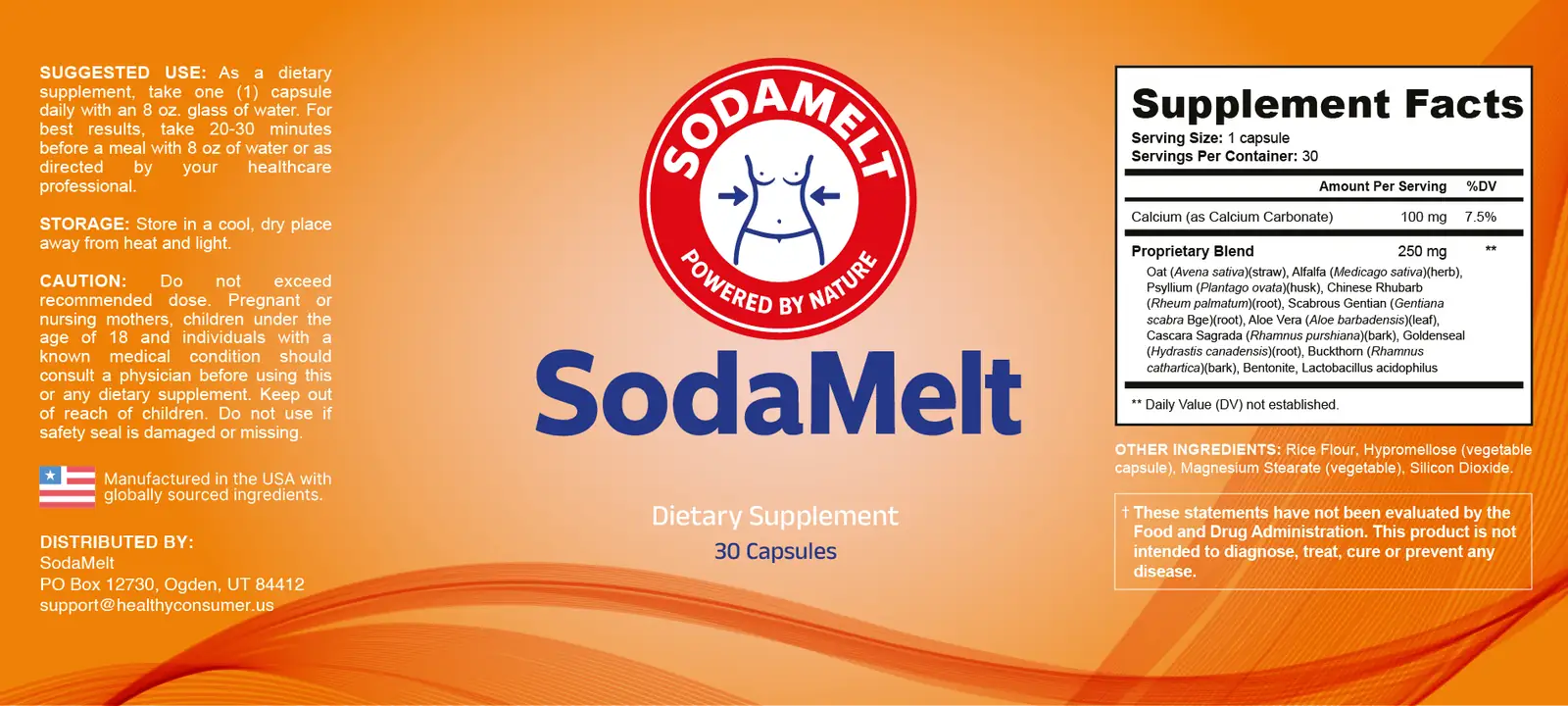
The photograph is the artwork itself rather than a redrawing of it, so the two rows, the footnote and the botanical list can be read in the original type. The supplement facts page takes the same panel line by line, including the serving arithmetic and the inactive row.
Which botanicals are in the SodaMelt blend?
Eleven names in label order, with the plant part each one is taken from.
| # | Name | Latin name and plant part | What kind of ingredient it is |
|---|---|---|---|
| 1 | Oat | Avena sativa, straw | nutritive herb, stem |
| 2 | Alfalfa | Medicago sativa, herb | nutritive herb |
| 3 | Psyllium | Plantago ovata, husk | gel-forming soluble fibre |
| 4 | Chinese Rhubarb | Rheum palmatum, root | anthranoid stimulant laxative |
| 5 | Scabrous Gentian | Gentiana scabra Bge, root | bitter |
| 6 | Aloe Vera | Aloe barbadensis, leaf | anthranoid stimulant laxative |
| 7 | Cascara Sagrada | Rhamnus purshiana, bark | anthranoid stimulant laxative |
| 8 | Goldenseal | Hydrastis canadensis, root | botanical |
| 9 | Buckthorn | Rhamnus cathartica, bark | anthranoid stimulant laxative |
| 10 | Bentonite | no botanical source printed | binding clay |
| 11 | Lactobacillus acidophilus | no botanical source printed | live culture |
Label order, not order of importance. The right-hand column is this desk's classification of each plant, drawn from the sources cited on the cards below.
Sorted by what they do rather than by where they sit on the list, the eleven fall into five groups. One gel-forming fibre. Four anthranoid stimulants. Two nutritive herbs. One bitter, one binding clay and one live bacterial culture.
That spread is the reason a single blend figure is hard to reason about. A fibre and a stimulant laxative both move the bowel, by different routes and on different timescales, and a reader with 250 mg in front of them cannot tell which of the two this capsule leans on.
What does each SodaMelt ingredient do?
One card per name, with the amount its own research used set beside it.
Calcium
as calcium carbonate100 mg · 7.5% of the Daily ValueThe one ingredient on this bottle with a number of its own, and the only row on the panel a buyer can check against anything. Calcium carbonate is the chalk in an antacid tablet and the grit in a cuttlefish bone, and it is roughly 40 per cent elemental calcium by weight, so 100 mg of the mineral comes from about 250 mg of the salt.
Two things follow from that figure. It is a small share of an adult daily intake, which the panel's own 7.5 per cent says out loud, and it needs stomach acid to dissolve, which is why the 2025 absorption work on short-term carbonate gave it with food. The label's instruction to take the capsule 20 to 30 minutes before a meal sits slightly across that grain, and the one capsule a day is not enough carbonate to work as an antacid in its own right.
Psyllium
Plantago ovata, huskInside the 250 mg blendThe strongest ingredient on this label by weight of published evidence, and the one worth reading the arithmetic for. Psyllium husk is a gel-forming soluble fibre: it takes up water in the small bowel, holds it through the colon and comes out again still holding it, which is why McRorie's review of stool output separates it from wheat bran so firmly.
The trials behind its reputation ran in grams. The Bijkerk primary-care trial gave 10 g a day for twelve weeks, the 2022 fibre meta-analysis pooled studies at more than 10 g a day over four weeks or longer, and the lipid meta-analysis sat around 10.2 g. The whole blend on this bottle is 250 mg. Psyllium is somewhere inside it, and even if it were the entire 250 mg that is a fortieth of the trial amount.
Oat
Avena sativa, strawInside the 250 mg blendStraw is the threshed stem left standing after the grain is taken off, and it is a different material from the oat most readers picture. The 2024 chemical study of oat straw maps it as a lipophilic profile of sterols, fatty acids and waxes that shifts with the season it was cut in.
That matters because the famous oat number belongs to the grain. The cholesterol meta-analysis used 3 g a day or more of beta-glucan, the soluble fibre concentrated in the bran layer of the kernel. Straw is not where beta-glucan lives, so the oat figure most people carry in their heads has no route onto this panel. Oat herb extract has its own small literature, mostly trials of attention and cognition, which is a separate subject from digestion.
Alfalfa
Medicago sativa, herbInside the 250 mg blendA deep-rooted legume grown mainly as fodder, sold as a green food for its mineral and vitamin content. There is no dose-finding trial in people for the digestive use it is here for, so the honest description is a nutritive herb rather than an active with a target.
Two entries in the literature are worth a buyer's attention and neither is about efficacy. The LactMed monograph records its vitamin K content, which is the reason it is advised against alongside warfarin, and a 2025 scoping review of immunostimulatory herbs lists alfalfa among the plants associated with lupus flares through the amino acid L-canavanine. Both belong on the side effects page, where they are set out at length.
Cascara Sagrada
Rhamnus purshiana, barkInside the 250 mg blendBark from a Pacific Northwest buckthorn, dried and aged before use, and one of the four anthranoid cathartics in this blend. Its active compounds are hydroxyanthracene derivatives, which pass the small bowel largely untouched and are converted by colonic bacteria into forms that stimulate the bowel wall and reduce water reabsorption.
This is a working mechanism rather than a gentle one. EFSA's 2024 opinion assessed preparations of this bark alongside rhubarb and frangula and concluded that their safety could not be established at any intake, which is why there is no reference amount here to set a milligram figure against. Cascara is also the ingredient that most firmly settles what kind of product this is.
Chinese Rhubarb
Rheum palmatum, rootInside the 250 mg blendNot the garden stalk. The medicinal root of Rheum palmatum has been used as a purgative for centuries, and it carries the same family of anthraquinones as cascara, including emodin and rhein. The same EFSA opinion covers it by name and reaches the same conclusion.
Rhubarb root is the second of the four stimulants, and the pairing is what makes this blend a laxative formula rather than a fibre formula with botanicals for colour. The 2023 review of melanosis coli lists rhubarb among the herbs behind the harmless brown pigmentation of the colon lining that a long anthraquinone habit produces, which a colonoscopist can see and which fades when the herb stops.
Buckthorn
Rhamnus cathartica, barkInside the 250 mg blendThe third stimulant, and the plainest-spoken of them: cathartica is in the botanical name. The LactMed entry describes buckthorn as containing anthraquinones with potent cathartic properties and advises against it during breastfeeding.
European herbal practice has long drawn a line between buckthorn bark that has been aged or heat-treated and bark used fresh, because fresh bark carries anthrones that cause cramping and vomiting. Which of the two arrived in this capsule is a manufacturing question the artwork settles no further than the plant part, and it is one of the reasons the batch record matters more on a blend like this than on a panel of single actives.
Aloe Vera
Aloe barbadensis, leafInside the 250 mg blendThe fourth stimulant, and the one most often misread, because two completely different materials come out of the same plant. The clear inner GEL is the one in the drinks aisle and the one the trials used. The LEAF, taken whole, includes the yellow latex just under the rind, which is where the anthraquinone aloin sits.
This panel prints leaf. The irritable bowel meta-analysis and the ulcerative colitis trial, which ran 100 mL of oral gel twice a day for four weeks, both tested gel. NCCIH's own summary separates the two and notes that oral latex preparations were removed from over-the-counter laxatives in the United States in 2002 for want of safety data.
Scabrous Gentian
Gentiana scabra Bge, rootInside the 250 mg blendA bitter root from the same genus as the gentian in aperitifs, and the one member of this blend with a genuinely different theory behind it. Bitters are held to work through taste receptors rather than through the bowel: the tongue registers the bitter iridoids and digestive secretion follows.
A 2015 profile of four Siberian gentians mapped the iridoid and flavonoid content and measured a gastric stimulatory effect in laboratory work, and a review of bitters sets out the receptor argument in full. Neither establishes a human amount, and a bitter sealed inside a capsule bypasses the tongue entirely, which is the awkward part of putting one in a swallowed shell.
Goldenseal
Hydrastis canadensis, rootInside the 250 mg blendA woodland root from eastern North America, traded for its berberine content and listed on CITES Appendix II because wild stands were dug faster than they regrew. In a digestion formula it is usually there for the bitter alkaloids and a traditional reputation for the gut lining.
Its best-documented property in people has nothing to do with digestion. Gurley's crossover study gave a standardised goldenseal supplement for fourteen days and measured clear inhibition of CYP3A, the enzyme system that clears a large share of prescription medicines, and a 2025 three-arm crossover in adults with type 2 diabetes found the interaction with metformin depends on the metformin dose. That is the single most checkable fact on this label and it belongs to who should not take it.
Bentonite
Inside the 250 mg blendA volcanic clay, mostly montmorillonite, that swells in water and carries a negative surface charge. In supplements it is sold as a binder that holds onto whatever passes it, and in industry the same property clarifies wine and lines ponds.
There is no established oral amount, and the clearest published caution involves quantities far beyond what a capsule can hold: a paediatric case of severe hypokalaemia followed oral and rectal clay administration. A binding clay in the same capsule as a mineral and a live culture is also the reason this desk does not describe the calcium row as a nutritional contribution.
Lactobacillus acidophilus
Inside the 250 mg blendThe only living ingredient in the capsule, and the one where the missing figure is a different kind of missing. Probiotics are counted in colony-forming units rather than milligrams, and a CFU count is what tells a reader whether a culture is a working dose or a decoration.
The trials that built this species' reputation in irritable bowel ran at 1 x 10¹⁰ CFU a day for six to eight weeks: the LAPIBSS trial, its two-strain successor and the DDS-1 study all sit in that region. Strain identity matters as much as count, and a 2024 shotgun metagenomic audit of US probiotic labels found label and contents disagreeing often enough to make the question worth asking of any product.
Why the plant part on the SodaMelt label changes the answer
Two of these plants reach a label in more than one form, and the forms are not interchangeable.
| On this label | What the research used | Why the two are not the same material |
|---|---|---|
| Oat (Avena sativa) straw | Oat bran and oat grain, for beta-glucan | Beta-glucan concentrates in the kernel. Straw is the stem left after threshing |
| Aloe Vera (Aloe barbadensis) leaf | Inner leaf gel, 100 mL twice daily in the colitis trial | Whole leaf includes the latex layer, which carries aloin. Gel does not |
| Psyllium (Plantago ovata) husk | Psyllium husk, 10 g a day | Same material. Here the difference is quantity rather than botany |
| Cascara Sagrada (Rhamnus purshiana) bark | Aged bark in traditional and regulatory use | Fresh bark carries anthrones that cause cramping; ageing converts them |
Four rows where naming the part is the difference between a comparison that works and one that does not.
Naming the plant part in brackets is more than a good deal of this category bothers with, and it is the reason this page can compare anything at all. It also cuts both ways. Once the label says straw, the oat cholesterol literature stops applying, and once it says leaf, the aloe gel trials stop applying.
A shopper reading the twelve names on the seller's information page sees a recognisable cast: oats, aloe, psyllium, alfalfa. A shopper reading the bracket after each name sees something more specific, and in two cases something different from what the reputation of the plant would suggest.
How much of each herb is in SodaMelt?
The blend total against the amounts the published trials ran at.
One figure covers all 11 of them. The Proprietary Blend row reads 250 mg, and the botanical list underneath it runs without a second column. Calcium is the only ingredient on this bottle carrying an amount of its own.
What that figure does give a reader is a ceiling. No single botanical in the blend can exceed 250 mg, because 250 mg is the whole of it. Split evenly across 11 names, each would carry about 22.7 mg. Real blends are rarely even, so the true figure for any one name is somewhere between a trace and the ceiling, and the ceiling is the only end of that range anyone outside the factory can check.
Ten grams of psyllium is 10,000 mg. The entire SodaMelt blend is 250 mg. Even if psyllium were the whole blend and the other ten names were absent, the capsule would carry a fortieth of the trial amount.
None of that makes the capsule worthless, and it is worth saying why. The four anthranoids work at milligram scale rather than gram scale: a stimulant laxative does not need bulk to act, which is exactly why EFSA's 2018 opinion on hydroxyanthracene derivatives could not set a safe daily intake and why a 2025 survey of the Italian market measured what is actually reaching shelves. A blend this size can be inert on the fibre side and quite active on the stimulant side at the same time.
This is the one section on this page whose job is the gap. An NIH perspective on proprietary blends sets out the trade the format makes: the manufacturer keeps a recipe, the buyer loses the ability to compare. The rest of this page describes what is in the capsule, which is where the interesting material is.
What else is in a SodaMelt capsule?
The part of the label that says what holds the capsule together.
| Inactive ingredient | What it is there for |
|---|---|
| Rice Flour | Bulking agent, bringing a small powder up to capsule volume |
| Hypromellose | The capsule shell itself, a plant cellulose rather than gelatin |
| Magnesium Stearate (vegetable) | Flow agent, so the powder meters evenly into each shell |
| Silicon Dioxide | Anti-caking agent, keeping the powder dry and free-running |
Read off the artwork's Other Ingredients line, in the order it prints them.
Four inactives, all of them ordinary, and one of them answers a question buyers ask more often than any other on this category. A hypromellose shell is made from plant cellulose, so the capsule contains no gelatin and suits a vegetarian diet. Nothing on the artwork addresses vegan certification, kosher or halal status.
The artwork carries no allergen statement, so a reader with a specific allergy is better served by the order desk and the batch record than by this page. The batch verification page sets out what lot SOD-26/GO-2953 can and cannot answer.
Does the SodaMelt artwork match the SodaMelt panel?
Two pictures of the same formula, and they do not carry the same list.
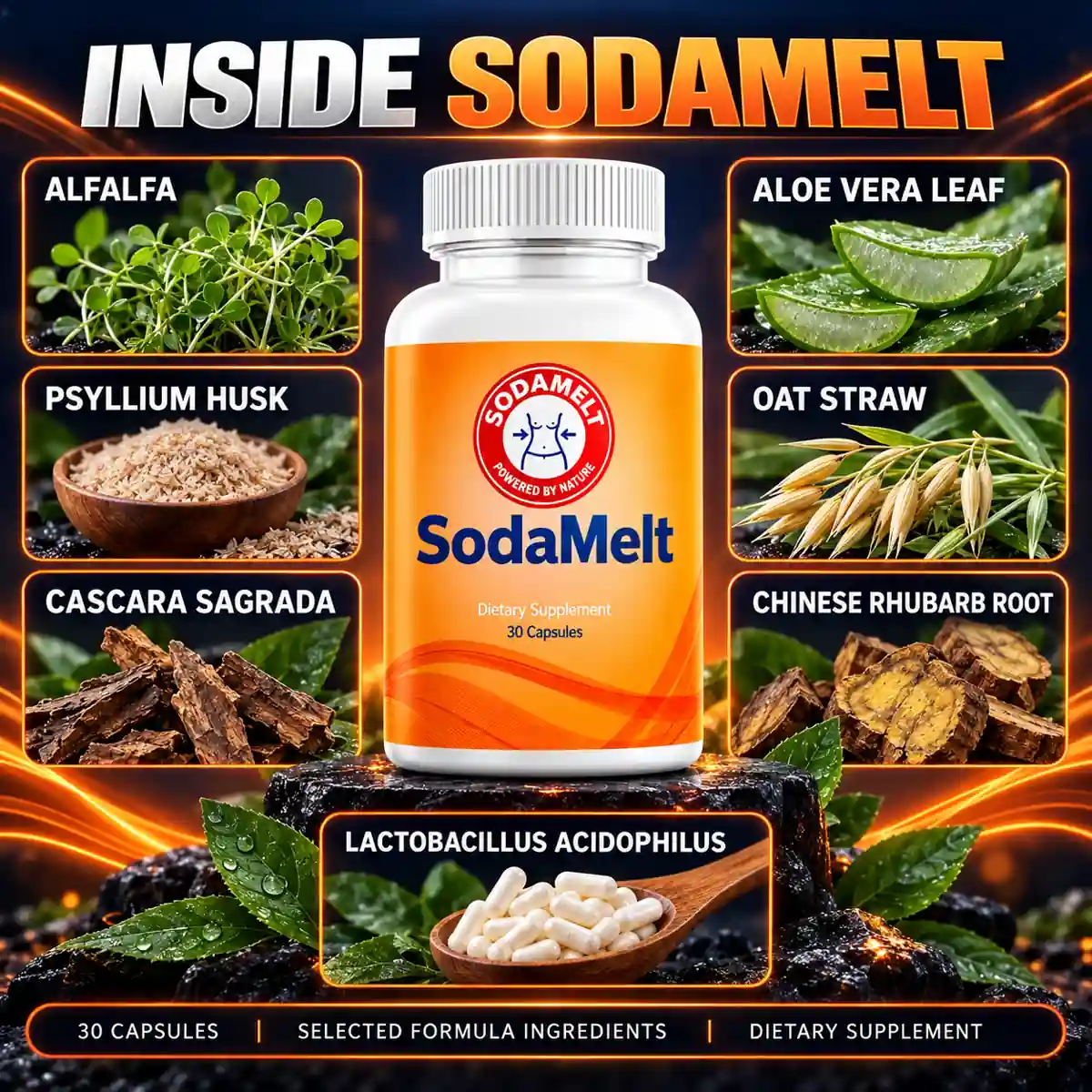
The seller's “Inside SodaMelt” graphic illustrates seven of the eleven botanicals and prints, in small type at its foot, the words SELECTED FORMULA INGREDIENTS. That wording is accurate and easy to read past.
Four names on the printed panel are absent from that graphic: Scabrous Gentian, Goldenseal, Buckthorn and Bentonite. Two of those four are anthranoid stimulants. A shopper who read only the graphic would come away with a gentler picture of the formula than the bottle supports, which is the practical reason this page works from the artwork rather than the marketing image.
SodaMelt ingredient questions
How many ingredients are in SodaMelt?
Twelve, counting calcium. The panel prints calcium carbonate on its own row and 11 botanicals inside a single 250 mg Proprietary Blend. Four inactive ingredients hold the capsule together and are listed separately.
Is there baking soda in SodaMelt?
No. Sodium bicarbonate appears nowhere on the Supplement Facts panel or the inactive line. The seller's information site opens with a story about natron and Victorian digestive biscuits, and the name of the product follows that story rather than the formula.
Which SodaMelt ingredients are laxatives?
Four of the eleven: Cascara Sagrada (bark), Chinese Rhubarb (root), Buckthorn (bark) and Aloe Vera (leaf). All four are anthranoid cathartics, which act on the colon wall. Psyllium husk also moves the bowel, by a different route, as bulk rather than stimulation.
Is SodaMelt vegetarian?
The shell is hypromellose, a plant cellulose, so there is no gelatin in the capsule and the magnesium stearate is the vegetable grade. The artwork makes no vegan, kosher or halal claim, and the live culture is a bacterial one.
Does SodaMelt contain fibre?
Psyllium husk is a soluble gel-forming fibre and it is one of the eleven names in the blend. How much of the 250 mg it accounts for is the question the panel leaves open, and the section on honest dosage above works through what the ceiling allows.
Where do the SodaMelt ingredient amounts come from?
The calcium figure is read off the panel. Every trial amount on this page came from the abstract of the study named beside it, and the studies are listed in full at the foot of the page with their PubMed identifiers.
Sources for the SodaMelt ingredient list
Every study named above, grouped by the ingredient it belongs to.
- Jain GK, Hasan N, Chandra N, et al. Absorption, Scintigraphy, Efficacy and Tolerability of Short-Term Calcium Carbonate Supplementation in Healthy Subjects. Cureus. 2025;17(7):e87642. PMID 40786390. https://pubmed.ncbi.nlm.nih.gov/40786390/
- Bijkerk CJ, de Wit NJ, Muris JW, et al. Soluble or insoluble fibre in irritable bowel syndrome in primary care? Randomised placebo controlled trial. BMJ. 2009;339:b3154. PMID 19713235. https://pubmed.ncbi.nlm.nih.gov/19713235/
- van der Schoot A, Drysdale C, Whelan K, et al. The Effect of Fiber Supplementation on Chronic Constipation in Adults: An Updated Systematic Review and Meta-Analysis of Randomized Controlled Trials. Am J Clin Nutr. 2022;116(4):953-969. PMID 35816465. https://pubmed.ncbi.nlm.nih.gov/35816465/
- Jovanovski E, Yashpal S, Komishon A, et al. Effect of psyllium (Plantago ovata) fiber on LDL cholesterol and alternative lipid targets, non-HDL cholesterol and apolipoprotein B: a systematic review and meta-analysis of randomized controlled trials. Am J Clin Nutr. 2018;108(5):922-932. PMID 30239559. https://pubmed.ncbi.nlm.nih.gov/30239559/
- McRorie JW Jr, Fahey GC Jr, Gibb RD, et al. Laxative effects of wheat bran and psyllium: Resolving enduring misconceptions about fiber in treatment guidelines for chronic idiopathic constipation. J Am Assoc Nurse Pract. 2020;32(1):15-23. PMID 31764399. https://pubmed.ncbi.nlm.nih.gov/31764399/
- Whitehead A, Beck EJ, Tosh S, et al. Cholesterol-lowering effects of oat beta-glucan: a meta-analysis of randomized controlled trials. Am J Clin Nutr. 2014;100(6):1413-21. PMID 25411276. https://pubmed.ncbi.nlm.nih.gov/25411276/
- Marques G, Gutierrez A, Barro F, et al. Seasonal Variability of Lipophilic Compounds in Oat (Avena sativa L.) Straw: A Comprehensive Chemical Study. J Agric Food Chem. 2024;72(36):19891-19903. PMID 39225266. https://pubmed.ncbi.nlm.nih.gov/39225266/
- Jibril AT, Arero AG, Kankam SB, et al. Effect of Avena sativa (Oats) on cognitive function: A systematic review of randomized controlled trials. Clin Nutr ESPEN. 2023;53:144-150. PMID 36657906. https://pubmed.ncbi.nlm.nih.gov/36657906/
- Alfalfa. Drugs and Lactation Database (LactMed). Bethesda (MD): National Institute of Child Health and Human Development; 2006-. Updated 21 June 2021. PMID 30000890. https://pubmed.ncbi.nlm.nih.gov/30000890/
- Weiner JD, Hill A, Shen C, et al. Identifying immunostimulatory herbal supplements that may flare autoimmune skin diseases: a systematic scoping review. Lupus Sci Med. 2025;12(2):e001803. PMID 41475897. https://pubmed.ncbi.nlm.nih.gov/41475897/
- Turck D, Bohn T, Castenmiller J, et al. Scientific Opinion on additional scientific data related to the safety of preparations of Rheum palmatum L., Rheum officinale Baill. and their hybrids, Rhamnus purshiana DC., Rhamnus frangula L. and Cassia senna L. EFSA J. 2024;22(5):e8766. PMID 38784839. https://pubmed.ncbi.nlm.nih.gov/38784839/
- Younes M, Aggett P, Aguilar F, et al. Safety of hydroxyanthracene derivatives for use in food. EFSA J. 2018;16(1):e05090. PMID 32625659. https://pubmed.ncbi.nlm.nih.gov/32625659/
- Peloso M, Capriotti A, Accurso D, et al. UPLC-MS/MS Analysis of Hydroxyanthracene Derivatives in Botanical Food Products and Supplements: Surveillance of the Italian Market. Foods. 2025;14(7):1229. PMID 40238473. https://pubmed.ncbi.nlm.nih.gov/40238473/
- Zhang R, Huang C, Wu F, et al. Review on melanosis coli and anthraquinone-containing traditional Chinese herbs that cause melanosis coli. Front Pharmacol. 2023;14:1160480. PMID 37214441. https://pubmed.ncbi.nlm.nih.gov/37214441/
- Buckthorn. Drugs and Lactation Database (LactMed). Bethesda (MD): National Institute of Child Health and Human Development; 2006-. Updated 21 June 2021. PMID 30000918. https://pubmed.ncbi.nlm.nih.gov/30000918/
- Hong SW, Chun J, Park S, et al. Aloe vera Is Effective and Safe in Short-term Treatment of Irritable Bowel Syndrome: A Systematic Review and Meta-analysis. J Neurogastroenterol Motil. 2018;24(4):528-535. PMID 30153721. https://pubmed.ncbi.nlm.nih.gov/30153721/
- Langmead L, Feakins RM, Goldthorpe S, et al. Randomized, double-blind, placebo-controlled trial of oral aloe vera gel for active ulcerative colitis. Aliment Pharmacol Ther. 2004;19(7):739-47. PMID 15043514. https://pubmed.ncbi.nlm.nih.gov/15043514/
- Aloe Vera. National Center for Complementary and Integrative Health, National Institutes of Health. https://www.nccih.nih.gov/health/aloe-vera
- Olennikov DN, Kashchenko NI, Chirikova NK, et al. Iridoids and Flavonoids of Four Siberian Gentians: Chemical Profile and Gastric Stimulatory Effect. Molecules. 2015;20(10):19172-88. PMID 26506331. https://pubmed.ncbi.nlm.nih.gov/26506331/
- McMullen MK, Whitehouse JM, Towell A. Bitters: Time for a New Paradigm. Evid Based Complement Alternat Med. 2015;2015:670504. PMID 26074998. https://pubmed.ncbi.nlm.nih.gov/26074998/
- Gurley BJ, Swain A, Hubbard MA, et al. Supplementation with goldenseal (Hydrastis canadensis), but not kava kava (Piper methysticum), inhibits human CYP3A activity in vivo. Clin Pharmacol Ther. 2008;83(1):61-9. PMID 17495878. https://pubmed.ncbi.nlm.nih.gov/17495878/
- Nguyen JT, Arian CM, Tanna RS, et al. The Pharmacokinetic Interaction Between Metformin and the Natural Product Goldenseal Is Metformin Dose-Dependent: A Three-Arm Crossover Study in Adults With Type 2 Diabetes. Clin Transl Sci. 2025;18(2):e70120. PMID 39943692. https://pubmed.ncbi.nlm.nih.gov/39943692/
- Bennett A, Stryjewski G. Severe hypokalemia caused by oral and rectal administration of bentonite in a pediatric patient. Pediatr Emerg Care. 2006;22(7):500-2. PMID 16871112. https://pubmed.ncbi.nlm.nih.gov/16871112/
- Sadrin S, Sennoune SR, Gout B, et al. Lactobacillus acidophilus versus placebo in the symptomatic treatment of irritable bowel syndrome: the LAPIBSS randomized trial. Cell Mol Biol (Noisy-le-grand). 2017;63(9):122-131. PMID 28980935. https://pubmed.ncbi.nlm.nih.gov/28980935/
- Sadrin S, Sennoune S, Gout B, et al. A 2-strain mixture of Lactobacillus acidophilus in the treatment of irritable bowel syndrome: A placebo-controlled randomized clinical trial. Dig Liver Dis. 2020;52(5):534-540. PMID 31952938. https://pubmed.ncbi.nlm.nih.gov/31952938/
- Martoni CJ, Srivastava S, Leyer GJ. Lactobacillus acidophilus DDS-1 and Bifidobacterium lactis UABla-12 Improve Abdominal Pain Severity and Symptomology in Irritable Bowel Syndrome: Randomized Controlled Trial. Nutrients. 2020;12(2):363. PMID 32019158. https://pubmed.ncbi.nlm.nih.gov/32019158/
- Gundogdu A, Karis G, Killpartrick A, et al. A Shotgun Metagenomics Investigation into Labeling Inaccuracies in Widely Sold Probiotic Supplements in the USA. Mol Nutr Food Res. 2024;68(12):e2300780. PMID 38856022. https://pubmed.ncbi.nlm.nih.gov/38856022/
- Saldanha LG, Dwyer JT, Hardy CJ, et al. Perspectives on the Use of Proprietary Blends in Dietary Supplements. J Nutr. 2023;153(5):1305-1308. PMID 37004873. https://pubmed.ncbi.nlm.nih.gov/37004873/
Order SodaMelt with the whole list in front of you
One capsule a day, 30 to a bottle, and 60 days from purchase to decide whether it suits you.
One bottle $89 · six bottles $294 · 60-day money-back guarantee
Order SodaMelt On The Official WebsiteOne capsule a day · 30 per bottle · lot SOD-26/GO-2953