SodaMelt Official Website › How it works
How it worksHow Does SodaMelt Work?
SodaMelt works by two different routes packed into the same capsule.
Psyllium husk holds water and adds bulk, which is slow and mechanical. Four anthranoid herbs act chemically on the colon wall after gut bacteria free them, which is faster. One 250 mg figure covers both, so the balance between them is not readable from the bottle.
Two mechanisms, five ingredient classes, and the timetable each one runs on.
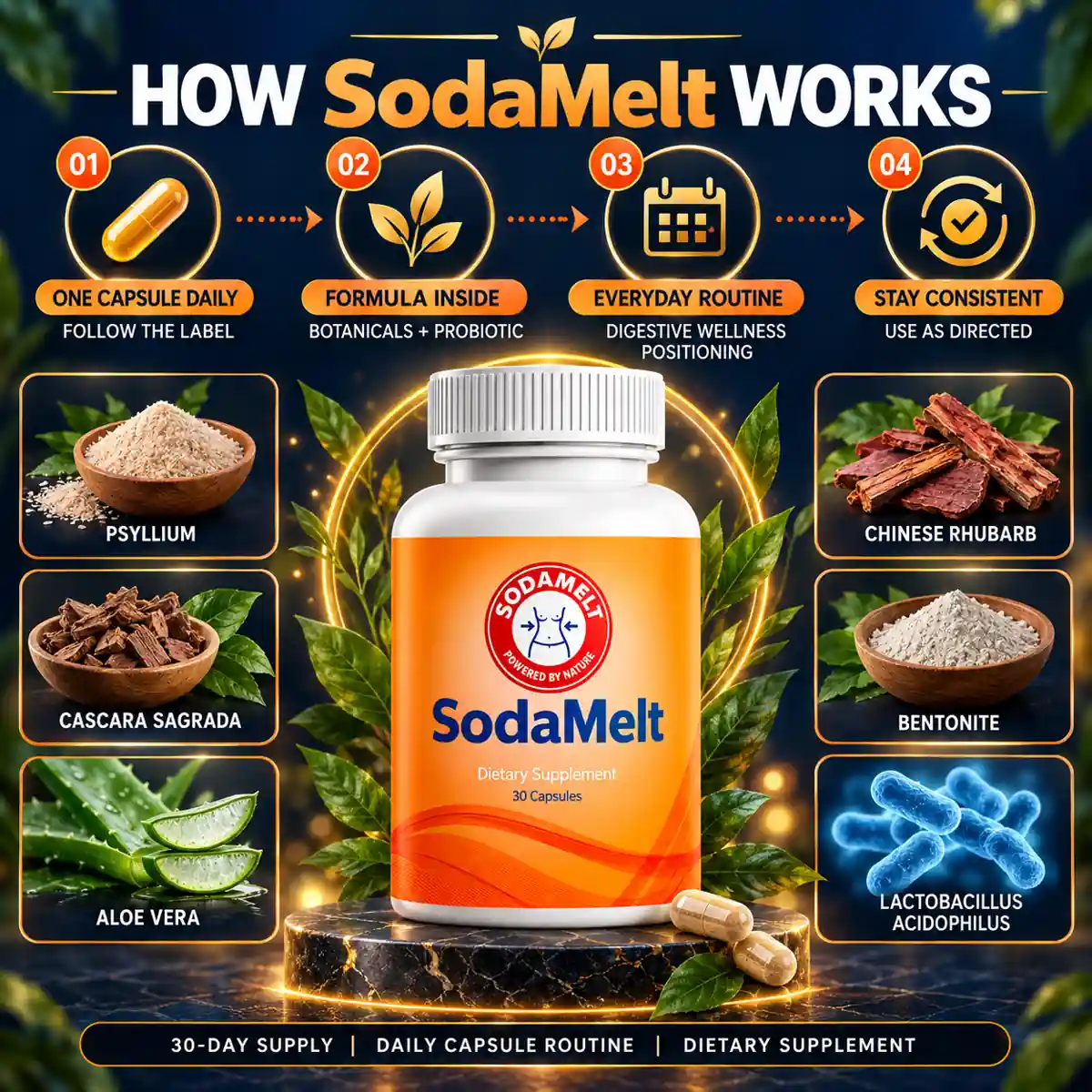
One capsule, taken with 8 oz of water, 20 to 30 minutes before a meal. What happens next depends on which of the eleven botanicals is carrying the most weight inside the blend.
What are the two mechanisms inside SodaMelt?
This capsule moves the bowel by two different routes, and they run on different timetables.
Bulk, from a gel-forming fibre
Psyllium husk takes on water and holds it. A hydrated gel raises stool water content, softens what is there and gives the bowel wall something to push against. It is slow, it is mechanical, and it depends entirely on the fluid swallowed with it.
Nothing about this route is chemical. It is the same principle as a sponge, and it is why McRorie's review insists on the distinction between a gel-forming fibre and a coarse insoluble one.
Stimulation, from four anthranoid herbs
Cascara sagrada, Chinese rhubarb, buckthorn and aloe leaf all carry hydroxyanthracene derivatives. These travel to the colon largely intact and are cut by gut bacteria into active aglycones, which act on the colonic wall to increase motility and reduce water reabsorption.
This route is chemical, it works at milligram scale, and it produces a result on a timetable of hours rather than days. Rao and Brenner's systematic review covers the class as over-the-counter therapy for chronic constipation.
Two mechanisms in one capsule is an unusual design, and it is the single most useful thing to understand about this formula. A fibre product and a stimulant product are sold to different people, on different expectations, with different advice about how long to use them.
Because one 250 mg figure covers both sides, a buyer cannot tell from the bottle which route is doing the work. The clock is the best available clue: a stimulant acts within a day, bulk fibre takes a week or more to show, and the wait most buyers report is measured in weeks.
How does the fibre in SodaMelt behave in the gut?
A gel-forming fibre works by physics, and the physics needs water.
Psyllium is not fermented to any great degree, which is the property that separates it from most soluble fibres. A fermentable fibre is eaten by colonic bacteria and produces gas as it goes; psyllium largely survives the trip and arrives still holding its water.
That is why it appears in guidance where other fibres do not. The ACG guideline on irritable bowel syndrome recommends soluble fibre, a network meta-analysis placed it among the better-supported options in that condition, and a Federal Register final rule governs psyllium in over-the-counter laxative products in granular form.
- Water is drawn in during the first hour after swallowing, which is why the label asks for 8 oz alongside the capsule.
- The hydrated husk holds that water through the small bowel instead of releasing it.
- In the colon the gel raises stool water content, which softens and adds volume.
- Volume gives the bowel wall something to work against, and transit follows.
- None of this is stimulation. Stopping a bulk fibre does not leave the bowel slower than it was.
The quantity question sits on the ingredients page rather than here, because it is an arithmetic point and this section is about mechanism. What belongs here is the dependency: a gel-forming fibre without fluid is a powder, and the published harm in this class is an obstruction case that followed psyllium swallowed dry.
What do the anthranoid herbs in SodaMelt do?
Four of the eleven botanicals act on the colon wall, and they do it by the same chemistry.
Anthranoids arrive in the colon as glycosides, which is to say the active part is attached to a sugar that keeps it inactive on the way down. Colonic bacteria cut that bond. The freed aglycones then act locally on the bowel wall, increasing motility and reducing the reabsorption of water.
That bacterial step is the reason the effect is delayed by hours rather than minutes, and the reason it varies between people: the microbiome doing the cutting is not the same in everyone.
The evidence on long use is genuinely contested, and this site cites both sides rather than picking one. EFSA's 2018 opinion could not establish a daily intake it considered safe for hydroxyanthracene derivatives, and the 2024 follow-up reached the same conclusion for rhubarb, cascara and frangula preparations specifically. Against that, Whorwell's 2024 critical review argues that a good deal of the case against stimulant laxatives is confounded by the condition they are given for, and Rao and Brenner graded senna, the best-studied member of the class, grade A for chronic constipation.
The pigmentation question is settled more cleanly. Long anthraquinone use produces melanosis coli, a brown discolouration of the colon lining, which the 2023 review describes as benign and reversible, and a worldwide meta-analysis examined for any association with neoplasia. The National Toxicology Program's emodin studies sit behind much of the regulatory caution about individual compounds in this family.
What are the other SodaMelt ingredients doing?
A bitter, a clay, a culture and a mineral, each on its own theory.
The bitter
Scabrous gentian root belongs to a tradition where bitterness itself is the active principle: taste receptors register it and digestive secretion follows. A review of bitters sets out the argument. A capsule shell dissolves past the tongue, which removes the step the theory depends on.
The clay
Bentonite swells and binds. In a formula that also carries a mineral and a live culture, that property is worth noticing, since a binder does not choose what it holds onto. There is no established oral amount for it.
The culture
Lactobacillus acidophilus is measured in colony-forming units. A 2026 meta-analysis with trial sequential analysis is the current summary of probiotics in irritable bowel, and the species-specific trials ran at 1 x 10¹⁰ CFU a day. A milligram figure cannot be converted into a colony count.
The mineral
Calcium carbonate at 100 mg is 7.5 per cent of a daily reference intake. It needs acid to dissolve, and the short-term absorption study gave it with food. At this amount it is a nutritional line rather than a digestive mechanism.
Four ingredients, four different theories, and none of them is the reason this capsule would be noticed. The fibre and the anthranoids carry the formula; the rest are the supporting cast, and a buyer choosing between products is better served weighing the two main routes than counting names.
How quickly does each part of SodaMelt act?
Five ingredient classes, five different answers to how long.
| Route | Where it acts | When a change would show | What it depends on |
|---|---|---|---|
| Anthranoid stimulants | Colon wall, after bacterial conversion | Within a day, on published pharmacology of the class | The amount inside the blend, which the panel does not break out |
| Psyllium gel | Small bowel and colon, as hydrated bulk | Days to weeks, in the trials that measured it | Fluid intake, and a quantity far above what a capsule holds |
| Live culture | Colon, if the organisms survive the journey | Six to eight weeks in the trials on this species | A colony count, which is a different unit from milligrams |
| Bitter root | Upper gut, through taste receptors | Minutes, when it is tasted | Contact with the tongue, which a sealed capsule prevents |
| Calcium carbonate | Stomach, needing acid to dissolve | Not a digestive effect at this amount | Taken with food, in the absorption work |
Timings describe each ingredient class in the published literature, not a prediction about this capsule.
Reading down that table explains most of what buyers report. The seller's own review summary puts the common wait at 4–8 weeks, which matches neither a stimulant's overnight action nor a bitter's immediate one, and sits closer to the probiotic and fibre timetables.
One reading of that is that the stimulant fraction is small. Another is that people are describing a settled routine rather than a first effect. The results timeline takes that apart week by week.
What SodaMelt cannot do, on its own label
The claims ceiling, and what sits under it.
The bottle itself makes no structure or function claim at all. Its printed words are the product name, the phrase Dietary Supplement, the panel, the suggested use, the storage and caution blocks, the sourcing line, the roundel strapline and the FDA disclaimer. The three supports this site names come from the seller's own page, not from the artwork.
So a mechanism section can describe how an ingredient class behaves in the literature, and it can set that beside the label's ceiling. What it cannot do is promise that this capsule reproduces a trial result, and nothing on this website does.
What the SodaMelt formula has going for it
- Names the plant part for every botanical, which most blends in this category skip.
- Prints a real milligram figure for calcium rather than folding it into the blend.
- Carries psyllium husk, the fibre with the strongest evidence in this category.
- Uses a hypromellose shell, so the capsule suits a vegetarian diet.
- Backs the purchase with 60 days, which is longer than the wait its own buyers report.
Where the label leaves a reader guessing
- One 250 mg figure covers 11 names, so no botanical can be compared with its own research.
- Four anthranoid stimulants sit in a formula the seller describes as free of harsh laxatives.
- The oat is straw rather than grain, so the familiar oat fibre evidence does not reach it.
- The live culture carries no colony count, which is the unit probiotic trials use.
- The name points at sodium bicarbonate, which appears nowhere on the panel.
Both columns are read off the same artwork. A buyer who wants a fibre supplement with a checkable dose is not looking at the right bottle; a buyer who wants a botanical digestion capsule with a stimulant fraction and a long refund window is looking at exactly this one.
How SodaMelt works: common questions
How long does SodaMelt take to work?
It depends which ingredient is doing the work. Anthranoid stimulants act within a day in the published pharmacology of the class; a fibre gel takes days to weeks; the live culture trials ran six to eight weeks. The seller's review summary puts the common wait at 4–8 weeks.
Is SodaMelt a laxative?
Four of the eleven botanicals in the blend are anthranoid stimulant laxatives, and psyllium husk is a bulk-forming one. The seller's information page describes the product as working without harsh laxatives, and that description does not match the panel it is printed alongside.
Does SodaMelt work without changing anything else?
The label asks for 8 oz of water with every capsule, so at least one thing changes by instruction. Fluid, fibre from food, activity and sleep all move the same things this capsule is sold for, which makes a single-variable test harder than it sounds.
Does SodaMelt work as an antacid?
Calcium carbonate is the active in many antacid tablets, but those carry several hundred milligrams to more than a gram. One capsule here holds 100 mg of calcium, which is a nutritional amount rather than a neutralising one.
Why does SodaMelt tell me to take it before a meal?
Twenty to thirty minutes before eating is the traditional timing for a bitter, which is meant to prime digestive secretion before food arrives. It runs slightly against the calcium carbonate evidence, where absorption was measured with food.
Can the ingredients in SodaMelt be checked independently?
The plant names and parts can, against the artwork. The amounts cannot, since only calcium carries one. Lot SOD-26/GO-2953 and certificate reference SOD-2953-26-GO index the batch at the order desk, and the batch page explains what each reference covers.
Sources behind the SodaMelt mechanism
The literature for each ingredient class described above.
- McRorie JW Jr, Fahey GC Jr, Gibb RD, et al. Laxative effects of wheat bran and psyllium: Resolving enduring misconceptions about fiber in treatment guidelines for chronic idiopathic constipation. J Am Assoc Nurse Pract. 2020;32(1):15-23. PMID 31764399. https://pubmed.ncbi.nlm.nih.gov/31764399/
- Lacy BE, Pimentel M, Brenner DM, et al. ACG Clinical Guideline: Management of Irritable Bowel Syndrome. Am J Gastroenterol. 2021;116(1):17-44. PMID 33315591. https://pubmed.ncbi.nlm.nih.gov/33315591/
- Black CJ, Yuan Y, Selinger CP, et al. Efficacy of soluble fibre, antispasmodic drugs, and gut-brain neuromodulators in irritable bowel syndrome: a systematic review and network meta-analysis. Lancet Gastroenterol Hepatol. 2020;5(2):117-131. PMID 31859183. https://pubmed.ncbi.nlm.nih.gov/31859183/
- Laxative drug products for over-the-counter human use; psyllium ingredients in granular dosage forms. Final rule. Fed Regist. 2007;72(60):14669-74. PMID 17450664. https://pubmed.ncbi.nlm.nih.gov/17450664/
- Rao SSC, Brenner DM. Efficacy and Safety of Over-the-Counter Therapies for Chronic Constipation: An Updated Systematic Review. Am J Gastroenterol. 2021;116(6):1156-1181. PMID 33767108. https://pubmed.ncbi.nlm.nih.gov/33767108/
- Younes M, Aggett P, Aguilar F, et al. Safety of hydroxyanthracene derivatives for use in food. EFSA J. 2018;16(1):e05090. PMID 32625659. https://pubmed.ncbi.nlm.nih.gov/32625659/
- Turck D, Bohn T, Castenmiller J, et al. Scientific Opinion on additional scientific data related to the safety of preparations of Rheum palmatum L., Rheum officinale Baill. and their hybrids, Rhamnus purshiana DC., Rhamnus frangula L. and Cassia senna L. EFSA J. 2024;22(5):e8766. PMID 38784839. https://pubmed.ncbi.nlm.nih.gov/38784839/
- Whorwell P, Lange R, Scarpignato C. Review article: do stimulant laxatives damage the gut? A critical analysis of current knowledge. Ther Adv Gastroenterol. 2024;17:17562848241249664. PMID 38887508. https://pubmed.ncbi.nlm.nih.gov/38887508/
- Zhang R, Huang C, Wu F, et al. Review on melanosis coli and anthraquinone-containing traditional Chinese herbs that cause melanosis coli. Front Pharmacol. 2023;14:1160480. PMID 37214441. https://pubmed.ncbi.nlm.nih.gov/37214441/
- Katsumata R, Manabe N, Fujita M, et al. Colorectal neoplasms in melanosis coli: a survey in Japan and a worldwide meta-analysis. Int J Colorectal Dis. 2021;36(10):2177-2188. PMID 34156546. https://pubmed.ncbi.nlm.nih.gov/34156546/
- NTP Toxicology and Carcinogenesis Studies of EMODIN (CAS No. 518-82-1) Feed Studies in F344/N Rats and B6C3F1 Mice. Natl Toxicol Program Tech Rep Ser. 2001;493:1-278. PMID 12563347. https://pubmed.ncbi.nlm.nih.gov/12563347/
- McMullen MK, Whitehouse JM, Towell A. Bitters: Time for a New Paradigm. Evid Based Complement Alternat Med. 2015;2015:670504. PMID 26074998. https://pubmed.ncbi.nlm.nih.gov/26074998/
- Tang ASP, Quek J, Sulaimi F, et al. Probiotics for Irritable Bowel Syndrome: An Updated Systematic Review and Meta-Analysis With Trial Sequential Analysis. J Gastroenterol Hepatol. 2026;41(4):1131-1146. PMID 41820241. https://pubmed.ncbi.nlm.nih.gov/41820241/
- Jain GK, Hasan N, Chandra N, et al. Absorption, Scintigraphy, Efficacy and Tolerability of Short-Term Calcium Carbonate Supplementation in Healthy Subjects. Cureus. 2025;17(7):e87642. PMID 40786390. https://pubmed.ncbi.nlm.nih.gov/40786390/
Order SodaMelt and give the routine a fair run
One capsule a day with a full glass of water, 30 to a bottle, and 60 days from purchase to decide.
One bottle $89 · six bottles $294 · 60-day money-back guarantee
Order SodaMelt On The Official WebsiteOne capsule a day · 30 per bottle · lot SOD-26/GO-2953