SodaMelt Official Website › Choosing a supplement
Choosing a supplementChoosing A Digestive Supplement: Seven Checks
Seven questions answer most of what a label can be held to, and all seven can be answered from the panel and the seller’s own pages in about five minutes. The second half of this page runs them on the product this website stocks and publishes the score, which comes back four no, two yes and one partial.
A scorecard you can carry to any bottle, then used on the bottle behind this website.
Why a checklist beats a comparison
Why seven questions travel better than any league table of products.
Comparison articles in this aisle collapse quickly, because the products are not comparable. One carries a gram of psyllium, the next carries eleven herbs inside a single 250 milligram figure, and a third carries a colony count and nothing else. Ranking them in a table implies a common axis that does not exist.
What does transfer between products is the set of questions. Each of the seven below is answerable yes or no from information the seller has already published, none of them requires a laboratory, and a product that answers all seven has told you what is in the bottle even if it has not told you that the bottle works.
Keep the two apart. This is a disclosure test, not an efficacy test, and confusing the two is how a well-labelled placebo gets mistaken for a well-evidenced product.
The seven checks
Three about the evidence, one about candour, one about live cultures, one about your money, one about the story.
| # | The question | What a yes looks like |
|---|---|---|
| 1 | Is an amount printed against every active ingredient? | A milligram or gram figure beside each name, with no line reading Proprietary Blend covering several of them at once. |
| 2 | Is the plant part named? | Husk, root, bark, leaf, seed, grain or aerial parts, in brackets or in the Latin, for every botanical on the panel. |
| 3 | Does the form match the form the trials used? | Gel where the trials used gel, grain where the trials used grain, husk where the trials used husk. |
| 4 | Are stimulant laxatives named as stimulant laxatives? | Anywhere on the label or the seller’s pages, the words that describe what cascara, rhubarb, buckthorn and aloe latex actually do. |
| 5 | If a live culture is claimed, is a colony count and a strain given? | A figure in colony forming units and a strain designation, not just a species name. |
| 6 | Is there a refund route with a number, an address and a written procedure? | A telephone number that reaches an order desk, a stated returns address and steps you can read before buying. |
| 7 | Does the seller’s story match the panel? | Every mechanism described on the sales page traceable to something printed on the Supplement Facts panel. |
Seven questions, answerable from the panel, the returns page and the sales copy. No laboratory required for any of them.
Checks one to three decide whether the research a seller gestures at applies to the bottle at all. Check four decides whether you have been told how the product works. Check five is the one most often failed outright, because a colony count is easy to omit and hard to notice missing.
Check six is the practical one and it protects a buyer more reliably than any badge on the pack. Check seven is the cheapest to run and the most revealing: read the sales page, then read the panel, and count how many of the mechanisms survive the journey.
The same seven, run on SodaMelt
Seven answers, four of them unfavourable, on the website that stocks the product.
| Check | Answer | Why |
|---|---|---|
| 1. Amounts printed for every active | No | Two rows. Calcium carries 100 mg; a Proprietary Blend carries 250 mg covering 11 botanicals with no individual figure. |
| 2. Plant part named | Yes | Straw, herb, husk, root, leaf and bark are printed against the botanicals they belong to, with the Latin binomials beside them. |
| 3. Form matches the trials | No | Oat straw where the fibre research used the grain, and aloe leaf where the trials used gel. |
| 4. Stimulant laxatives named as such | No | Four of the eleven are anthranoid cathartics. The seller’s pages describe the formula as working without harsh laxatives. |
| 5. Colony count and strain | No | Lactobacillus acidophilus is named as a species, sealed inside the blend, with no colony forming units and no strain designation. |
| 6. Refund route with a number and an address | Yes | 60 days from purchase, a telephone order desk, a stated returns address and five written steps, opened bottles included. |
| 7. Seller’s story matches the panel | Partial | The fibre and probiotic story is on the panel. The baking-soda history the name invites is not: there is no sodium bicarbonate on this label. |
Two yes, four no and one partial, scored against the printed artwork rather than against the sales page.
Publishing that table on a website that sells the bottle is the point of having a scorecard at all. A checklist that a desk only applies to other people’s products is an advertisement with numbered paragraphs.
The four failures, in order of how much they cost
Four no answers, ranked by what each one actually removes from a buyer.
Check one is the expensive one and it makes checks three and five harder to answer rather than merely unfavourable. One figure of 250 mg covers 11 botanicals, which means that figure is the ceiling for any single one of them and an even split would be 22.7 mg each. Set that against the ten grams a day the constipation meta-analysis found benefit above and the arithmetic is not close.
Check four costs the product its framing. Cascara sagrada bark, Chinese rhubarb root, buckthorn bark and aloe vera leaf are anthranoid stimulant laxatives, LactMed describes them in those terms, and EFSA reviewed three of them by name in 2024. A buyer choosing a gentle daily capsule and a buyer choosing a stimulant laxative are making different decisions, and only one of them has been told which.
Check five is a clean miss rather than an argument. The Lactobacillus acidophilus trials ran at one times ten to the tenth colony forming units a day. This label prints no colony count, so there is nothing to set beside that figure, and a metagenomic audit of fifty American probiotics is the reason a count on a label is worth asking for in the first place.
Check three is the quietest and the easiest to miss. The oat cholesterol evidence is about beta-glucan from the grain, this panel carries oat straw, and straw is the threshed stem with a different chemistry. The same substitution happens with aloe: the colitis trial used gel and the panel says leaf.
The two passes, and what they are worth
Two yes answers, and why the second protects a buyer more than the first.
Check two is real and it is not common. Every botanical on this panel carries its Latin binomial and its plant part, which is more than a good deal of this aisle manages, and it is the only reason check three could be answered at all. A label that wrote Aloe Extract and stopped would have concealed the substitution rather than disclosed it.
Check six is the one a buyer can enforce. 60 days from the date of purchase, opened and empty bottles accepted, a telephone order desk, a stated returns address in New York and five written steps published before you buy. In an aisle where a guarantee is often a sentence with no procedure behind it, that is worth more than any seal on the pack.
The partial on check seven is worth a sentence of its own. The fibre-and-culture story on the seller’s pages does correspond to things printed on the panel. The baking-soda history the product name invites does not, because there is no sodium bicarbonate anywhere on this label, and a name is not a mechanism.
Running the same seven on anything else
What usually breaks first, and the order worth asking the questions in.
Take the list to the next label you look at. In practice most products in this aisle fail check one, because a proprietary blend remains the industry default, and a failure there makes checks three and five unanswerable rather than simply unfavourable.
The second commonest failure is check five. A panel naming a species with no strain and no colony count has said the minimum that is still true, and the pooled probiotic evidence is not strong enough to carry a product that will not say how much it contains.
The third is check seven, and it is the fastest to run. Read the sales page first and write down every mechanism it describes. Then read the panel and strike out every mechanism that has nothing on the panel behind it. What survives is the product; what you struck out is the copywriting.
A product passing all seven has established that the company will tell you what is in the bottle and take it back if you do not want it. That is worth having. It is still not evidence that the capsule works, and NCCIH’s guidance on using supplements wisely is a good habit to pair with the list.
What this checklist cannot tell you
Six things seven checks were never built to answer.
- Whether the formula works. A label can pass all seven and still be a capsule with no trial behind the finished product, which describes nearly everything on this shelf.
- Whether the amount in the capsule matches the amount on the panel, which is a laboratory question no checklist reaches.
- How strong the laxative effect of a blend is, which is the one thing a buyer most wants to know and the one thing a shared milligram figure cannot supply.
- Whether an ingredient suits you personally, which depends on what else you take and what you already have.
- Whether the price is fair. Cost per day is separate arithmetic and it belongs on the pricing page rather than on a scorecard.
- Whether your symptoms need something other than a supplement, which is the question worth answering before the other six.
The list is a disclosure test, and keeping that separate from an efficacy test is the whole discipline. The AGA update on bloating and distention covers what else the same sensation can be, MedlinePlus covers the slower end in plain language, and the companion guide walks the aisle ingredient by ingredient with the amounts each one’s trials used.
Who publishes this SodaMelt website?
- van der Schoot A, Drysdale C, Whelan K, et al. The Effect of Fiber Supplementation on Chronic Constipation in Adults: An Updated Systematic Review and Meta-Analysis of Randomized Controlled Trials. Am J Clin Nutr. 2022;116(4):953-969. PMID 35816465. https://pubmed.ncbi.nlm.nih.gov/35816465/
- Whitehead A, Beck EJ, Tosh S, et al. Cholesterol-lowering effects of oat beta-glucan: a meta-analysis of randomized controlled trials. Am J Clin Nutr. 2014;100(6):1413-21. PMID 25411276. https://pubmed.ncbi.nlm.nih.gov/25411276/
- Marques G, Gutierrez A, Barro F, et al. Seasonal Variability of Lipophilic Compounds in Oat (Avena sativa L.) Straw: A Comprehensive Chemical Study. J Agric Food Chem. 2024;72(36):19891-19903. PMID 39225266. https://pubmed.ncbi.nlm.nih.gov/39225266/
- Langmead L, Feakins RM, Goldthorpe S, et al. Randomized, double-blind, placebo-controlled trial of oral aloe vera gel for active ulcerative colitis. Aliment Pharmacol Ther. 2004;19(7):739-47. PMID 15043514. https://pubmed.ncbi.nlm.nih.gov/15043514/
- Cascara Sagrada. Drugs and Lactation Database (LactMed). Bethesda (MD): National Institute of Child Health and Human Development; 2006-. Updated 17 May 2021. PMID 30000387. https://pubmed.ncbi.nlm.nih.gov/30000387/
- Turck D, Bohn T, Castenmiller J, et al. Scientific Opinion on additional scientific data related to the safety of preparations of Rheum palmatum L., Rheum officinale Baill. and their hybrids, Rhamnus purshiana DC., Rhamnus frangula L. and Cassia senna L. EFSA J. 2024;22(5):e8766. PMID 38784839. https://pubmed.ncbi.nlm.nih.gov/38784839/
- Sadrin S, Sennoune S, Gout B, et al. A 2-strain mixture of Lactobacillus acidophilus in the treatment of irritable bowel syndrome: A placebo-controlled randomized clinical trial. Dig Liver Dis. 2020;52(5):534-540. PMID 31952938. https://pubmed.ncbi.nlm.nih.gov/31952938/
- Tang ASP, Quek J, Sulaimi F, et al. Probiotics for Irritable Bowel Syndrome: An Updated Systematic Review and Meta-Analysis With Trial Sequential Analysis. J Gastroenterol Hepatol. 2026;41(4):1131-1146. PMID 41820241. https://pubmed.ncbi.nlm.nih.gov/41820241/
- Gundogdu A, Karis G, Killpartrick A, et al. A Shotgun Metagenomics Investigation into Labeling Inaccuracies in Widely Sold Probiotic Supplements in the USA. Mol Nutr Food Res. 2024;68(12):e2300780. PMID 38856022. https://pubmed.ncbi.nlm.nih.gov/38856022/
- Saldanha LG, Dwyer JT, Hardy CJ, et al. Perspectives on the Use of Proprietary Blends in Dietary Supplements. J Nutr. 2023;153(5):1305-1308. PMID 37004873. https://pubmed.ncbi.nlm.nih.gov/37004873/
- Moshiree B, Drossman D, Shaukat A. AGA Clinical Practice Update on Evaluation and Management of Belching, Abdominal Bloating, and Distention: Expert Review. Gastroenterology. 2023;165(3):791-800.e3. PMID 37452811. https://pubmed.ncbi.nlm.nih.gov/37452811/
- Constipation. MedlinePlus, National Library of Medicine, National Institutes of Health. https://medlineplus.gov/constipation.html
- Using Dietary Supplements Wisely. National Center for Complementary and Integrative Health, National Institutes of Health. https://www.nccih.nih.gov/health/using-dietary-supplements-wisely
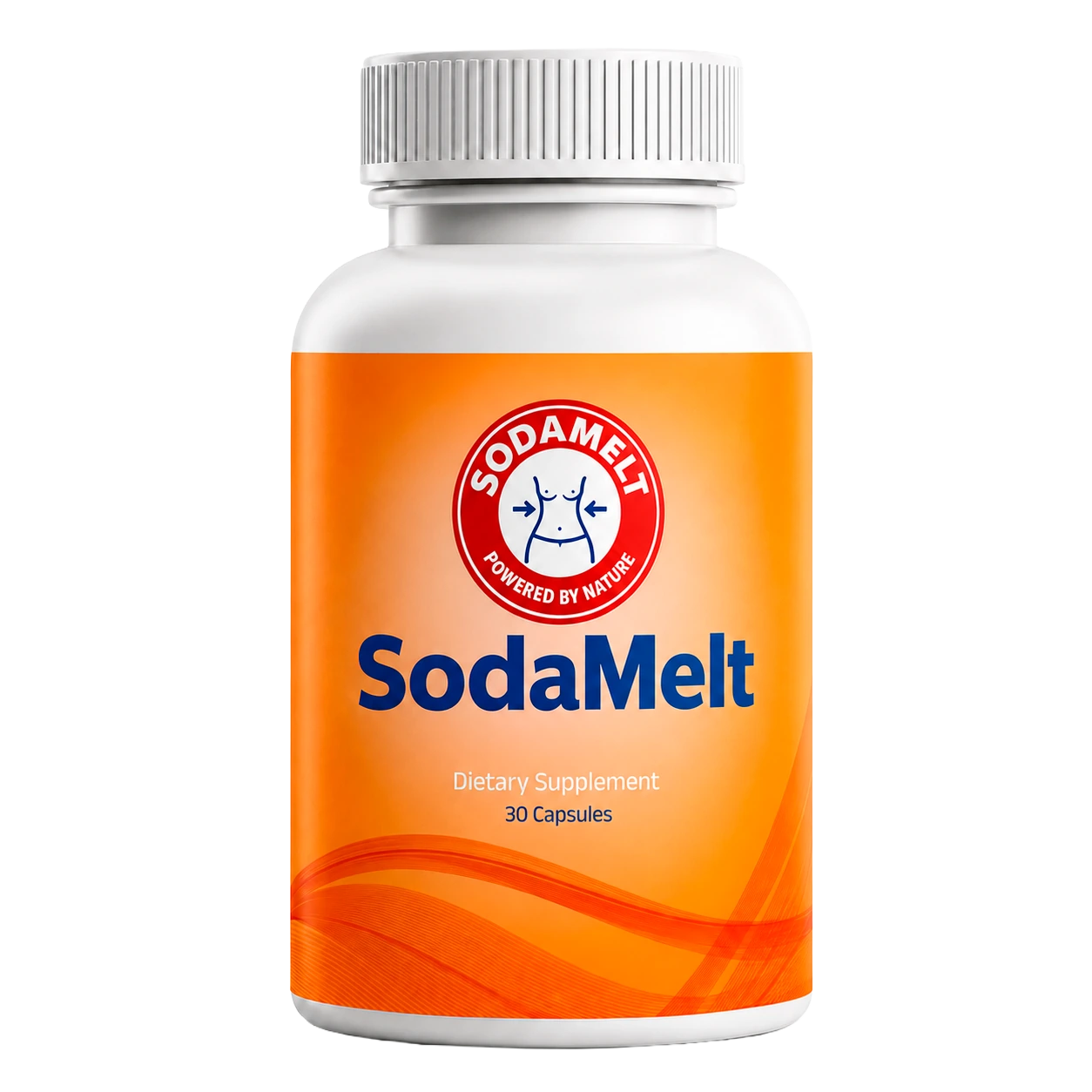
Order SodaMelt with the scorecard in front of you
Two passes, one partial and four failures, every one of them checkable against the printed panel. $49 to $89 a bottle with 60 days from purchase to change your mind.
One bottle $89 · six bottles $294 · 60-day money-back guarantee
Order SodaMelt On The Official WebsiteOne capsule a day · 30 per bottle · lot SOD-26/GO-2953