SodaMelt Official Website › Blog › Chinese Rhubarb Root Is Not The Pie Plant
Chinese Rhubarb Root Is Not The Pie Plant
Say rhubarb and most people picture a pink stalk in a crumble. The fourth name in the SodaMelt blend is a different thing: the dried root of Rheum palmatum, prized for chemistry that is nothing like a dessert. This article separates the plant's three parts, sets out what the one randomised trial of a rhubarb extract dosed, and says what a 250 mg blend can and cannot tell you about it.
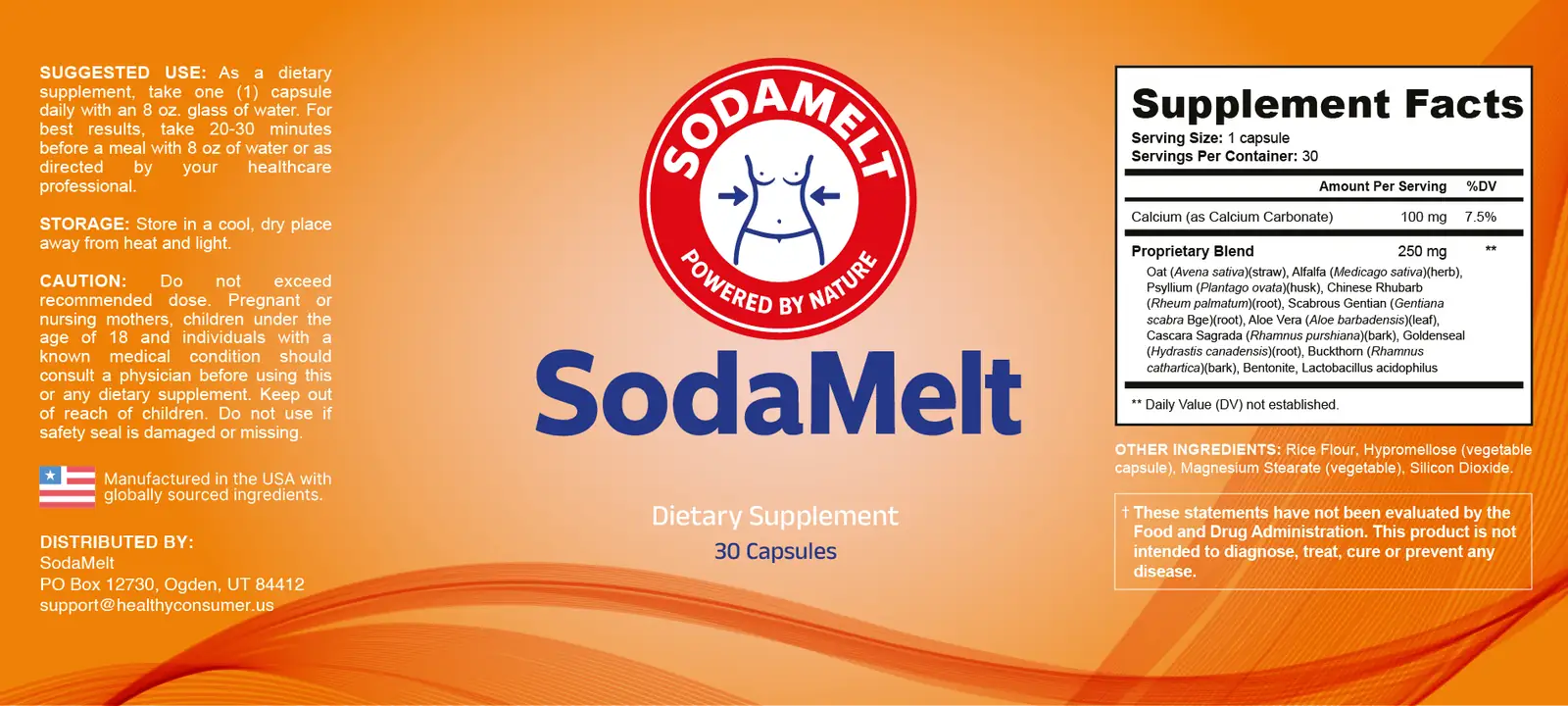
- The panel prints "Chinese Rhubarb (Rheum palmatum)(root)". Root, stalk and leaf are three materials with three different uses and risks.
- The root carries anthraquinones including emodin, rhein, chrysophanol, aloe-emodin and physcion. Those are the compounds behind its use as a laxative.
- The one placebo-controlled trial found here dosed a rhubarb extract by its rhein content, 12.5 or 25 mg a day for 30 days. The panel prints no rhein figure.
- A DNA study of the wider Chinese rhubarb supply chain identified 25 percent of 36 commercial samples as adulterants, so identity is a live question and not a formality.
- Regulators have not cleared these preparations. EFSA's 2024 opinion says their safety cannot be established from the studies submitted, while a 2022 laboratory study of one extract found no genotoxicity in vitro.
One word, three plant parts
Rhubarb is a plant with a split personality. The stalks of the garden species are food, and the drug reference the National Library of Medicine hosts notes that Chinese and garden rhubarb are generally recognised as safe as a food (the LactMed entry on rhubarb). The leaves are another matter. Two reports from the early 1960s in a Finnish paediatric journal describe oxalic acid poisoning from eating rhubarb leaves, one of them the death of a child (a report of a death from rhubarb leaves, a report on rhubarb leaves as a cause of oxalic acid poisoning).
The root is the third material and the medicine. A recent review describes rhubarb, in its medicinal sense, as the root and rhizome of Rheum officinale, Rheum tanguticum or Rheum palmatum (the review of rhubarb's uses and pharmacology). Rheum palmatum is the one printed on this panel. The LactMed entry describes the root as containing anthraquinones, which are cathartics, and tannins, which are astringents, and notes that most of the conditions for which it has been used are not supported by well-controlled trials.
| Part of the plant | What it is used as | What it contains that matters |
|---|---|---|
| Stalk | A food, cooked with sugar | Not the subject of this article |
| Leaf | Not a food | Oxalic acid, with poisoning reports on record |
| Root and rhizome | The traditional medicine, and the row on this panel | Anthraquinones, anthrones and tannins |
A panel that says only rhubarb has not told you which of these three. This panel says root, which is the useful thing it does.
Naming the part is not a small courtesy. It is what makes the row checkable. A label that read only Chinese Rhubarb could describe a pantry item. One that says Rheum palmatum and root is pointing to a specific botanical drug with a known chemistry, and a reader can look that up.
What is actually in the root
The compounds that matter are the anthraquinones, of which the same review lists emodin, rhein, chrysophanol, aloe-emodin and physcion, along with their sugar-bound glycoside forms. This is the same chemical family as the other stimulant plants on the panel: cascara, buckthorn and the latex of aloe. The article on the four stimulant herbs covers the family's shared mechanism, in which the compounds reach the colon largely intact and are activated by gut bacteria.
Emodin, the best-studied of them, has its own review. It was used in traditional medicine for over 2,000 years, has a wide range of laboratory activities, and can also cause liver, kidney and reproductive toxicity, particularly at high doses and with long-term use. It is poorly absorbed by mouth in rats because it is extensively glucuronidated (the review of emodin's pharmacology and toxicity). Two points follow. The toxicity concerns are tied to dose and duration, which is why neither can be left out of the story. And a poorly absorbed compound is not an inactive one: the four stimulant herbs article describes how the laxative action happens in the gut itself.
The one trial, and the unit it used
Most claims about rhubarb rest on tradition. There is a modern placebo-controlled trial, though, and it is worth reading closely because it shows how much a dose depends on the unit.
Middle-aged volunteers in a constipation trial, 95 percent of them women with an average age of 58, were randomised to a rhubarb extract at one of two doses or to a placebo of maltodextrin, for 30 days. The two doses were defined by their rhein content: 12.5 mg and 25 mg of rhein a day. Stool frequency and consistency, and the participants' perception of transit and difficulty in evacuating, improved in both rhubarb groups compared with placebo, and the authors reported that supplementation was safe for the 30 days even at the higher dose (the randomised trial of rhubarb extract in middle-aged adults).
The trial went beyond stool counts. The authors looked at the gut microbiome and found higher abundance of a group of butyrate-producing bacteria, the Lachnospiraceae, but only in people who had low levels at the start. Short-chain fatty acid levels rose in both rhubarb groups and fell in the placebo group, and both were positively correlated with stool consistency. It is an interesting mechanism and it is worth knowing that the paper proposes it, though it is a proposal, and the trial was not designed to prove it.
That is real evidence, and it is worth saying so: it is the strongest single item of support for the plant that this research turned up. It also comes with three conditions that matter here.
- It was an extract. The trial used a standardised preparation, not root powder in a blend.
- It was dosed in rhein. The panel prints no rhein figure, and rhein is only part of the anthraquinone content of a root.
- It was a 30-day trial in people with constipation. That is a specific population and a specific duration.
One further detail of that trial design is worth keeping in view. The comparison was against a placebo of maltodextrin, an inert carbohydrate, which is what makes the result meaningful: the improvement in the rhubarb groups was measured against something that looked the same and did nothing. Most supplement claims are never tested that way. The trial also lasted 30 days, so it says what the extract did over a month, and nothing about what happens across a season. That matters for a stimulant-family plant, where duration is the main open question.
A 2022 laboratory study characterised one rhubarb rhizome extract as containing 1.39 percent total hydroxyanthracene derivatives. If a capsule's entire 250 mg were that extract, which it cannot be, the total would be about 3.5 mg of those compounds, of which rhein is only a part. The trial's lower dose was 12.5 mg of rhein alone. Different extracts differ, and this is one measurement of one extract. It is offered only to show the direction of the gap.
See exactly what the SodaMelt panel prints
Two rows, eleven botanicals inside one of them, every name and plant part on the label. One capsule a day with a full glass of water.
One bottle $89 · six bottles $294 · 60-day money-back guarantee
Order SodaMelt On The Official WebsiteOne capsule a day · 30 per bottle · lot SOD-26/GO-2953
Is the root what it says it is?
The question a panel cannot answer by itself is whether the material in the capsule is the plant on the label. For rhubarb there is unusually direct evidence that it is a fair question.
Researchers used DNA barcoding to trace Rhei Radix et Rhizoma along its whole industrial chain in China. They collected 110 samples, including leaves, seeds, roots, decoction pieces and finished traditional patent medicines. The standard, universal DNA barcodes could not tell the three official species apart, so they had to use a specific marker. With it, they clearly distinguished seven Rheum species at the farm end of the chain. Further down the chain, 25 percent of the 36 commercial decoction-piece samples were identified as adulterants, while all eight finished patent-medicine samples were genuine (the DNA barcoding study of the rhubarb supply chain).
Read that carefully. It is a study of the traditional medicine trade, not of US dietary supplements, and it does not say anything about the material in this bottle. It does establish that substitution in rhubarb root has happened at a measurable rate somewhere in the market, and that ordinary DNA tests could not tell the genuine species apart without a special marker. The label gives the name. Only a test can confirm it.
That is why the batch paperwork matters. The verify a batch page explains how to ask for the certificate of analysis for the lot on the bottle. Identity testing on a botanical is a normal item on one, and the certificate is the document where a name on a label becomes a result.
What regulators have and have not concluded
Rhubarb root is one of a group of hydroxyanthracene-containing plants that European regulators have looked at hard. The European Food Safety Authority's 2018 opinion concluded that hydroxyanthracene derivatives should be considered genotoxic and carcinogenic unless there are specific data to the contrary, such as for rhein, and it could not set an intake that raises no concern (EFSA's 2018 opinion on hydroxyanthracene derivatives).
Industry then submitted more data. EFSA's 2024 opinion on preparations of Rheum palmatum and Rheum officinale roots, alongside cascara and frangula bark and senna, found that all the genotoxicity studies on the plant preparations were negative. But it also found that the preparations tested were not sufficiently characterised, that they contained compounds known to be genotoxic in vivo or in vitro, and it concluded that the safety of these preparations could not be established from the submitted studies (EFSA's 2024 opinion on Rheum, Rhamnus and Cassia preparations).
There is a counterweight, and it should sit in the same paragraph. A 2022 laboratory study of an ethanolic extract of ground rhubarb rhizome found no genotoxic activity in the Ames test, in bacteria, or in a micronucleus test in human lymphocytes, up to 5,000 micrograms per plate or millilitre (the Ames and micronucleus study of rhubarb rhizome). Its authors note that no genotoxic activity has been reported for other rhubarb constituents such as rhein, physcion and chrysophanol.
The negative tests are on the record, and so is EFSA's position that the material tested was not well enough characterised to settle the question. Neither is a finding about a capsule taken for a month. What a reader can take from the pair is that the regulatory case is open, not closed, and that the risk discussion is about long-term exposure, a subject the seller's label does not address.
The pregnancy and nursing line
The bottle asks pregnant or nursing mothers to consult a physician first, and rhubarb is one row where the literature backs that up. A review of herbal laxatives in pregnancy found no human data on rhubarb and reported animal studies in which its emodin content induced fetal abnormalities (the review of herbal laxatives and antiemetics in pregnancy). The LactMed entry says most recent reviewers state that rhubarb should not be used during breastfeeding because of possible cathartic effects on the infant, even though two very old studies did not find it passing into milk.
The other rows on the panel have their own entries, and the caution line, row by row lays them out side by side.
Position four, and what it implies
Under the federal labelling rule, 21 CFR 101.36, a proprietary blend lists its ingredients in descending order of weight. Rhubarb root is fourth of eleven. That places it above the aloe, cascara, goldenseal and buckthorn, and below oat straw, alfalfa and psyllium.
The arithmetic is the one the blend article teaches. The whole blend is 250 mg, and an even split is 22.7 mg. A fourth-place ingredient is unlikely to be the smallest share, and equally cannot be more than the total. Beyond that, the label offers no way to say how large the share is, or what fraction of it is rhein.
Four questions for any rhubarb row
- Root, stalk or leaf? Only the root is the medicine, and this panel says root.
- Which species? The medicinal root is defined as three species, and a label that names one is doing better than one that says only rhubarb.
- What unit? The one trial dosed in rhein. A blend that prints a total in milligrams cannot be converted to that unit without the supplier's own analysis.
- For how long? The trial ran 30 days. Nothing in it speaks to months.
What this article is not saying
It is not saying rhubarb root is a bad ingredient. It is an old drug with a plausible mechanism and one modern trial behind it. It is not saying this capsule contains adulterated material, because nothing here supports that. And it is not saying the panel is misleading, because printing the Latin name and the plant part is exactly what a good label does.
It is saying that four things stand between the printed name and a working assumption. The part, which the panel gives. The species, which the panel gives and only a test can confirm. The amount and the unit, which the panel does not give. And the duration, which nothing in the trial or the panel gives beyond 30 days. A reader who keeps those four in view will read the next rhubarb row differently.
References
- Rhubarb. Drugs and Lactation Database (LactMed). Bethesda (MD): National Institute of Child Health and Human Development; 2006-. Read 26 September 2026. PMID 30000922. https://pubmed.ncbi.nlm.nih.gov/30000922/
- Tallqvist H, Vaananen I. Death of a child from oxalic acid poisoning due to eating rhubarb leaves. Ann Paediatr Fenn. 1960;6:144-7. PMID 13836748. https://pubmed.ncbi.nlm.nih.gov/13836748/
- Kalliala H, Kauste O. Ingestion of rhubarb leaves as cause of oxalic acid poisoning. Ann Paediatr Fenn. 1964;10:228-31. PMID 14166252. https://pubmed.ncbi.nlm.nih.gov/14166252/
- Miao H, Wang KE, Li P, Zhao YY. Rhubarb: Traditional Uses, Phytochemistry, Multiomics-Based Novel Pharmacological and Toxicological Mechanisms. Drug Des Devel Ther. 2025;19:9457-9480. PMID 41158982. https://pubmed.ncbi.nlm.nih.gov/41158982/
- Dong X, Fu J, Yin X, Cao S, Li X, Lin L, et al. Emodin: A Review of its Pharmacology, Toxicity and Pharmacokinetics. Phytother Res. 2016;30(8):1207-18. PMID 27188216. https://pubmed.ncbi.nlm.nih.gov/27188216/
- Neyrinck AM, Rodriguez J, Taminiau B, Herpin F, Cani PD, Daube G, et al. Constipation Mitigation by Rhubarb Extract in Middle-Aged Adults Is Linked to Gut Microbiome Modulation: A Double-Blind Randomized Placebo-Controlled Trial. Int J Mol Sci. 2022;23(23):14685. PMID 36499011. https://pubmed.ncbi.nlm.nih.gov/36499011/
- Xin T, Li R, Lou Q, Lin Y, Liao H, Sun W, et al. Application of DNA barcoding to the entire traditional Chinese medicine industrial chain: A case study of Rhei Radix et Rhizoma. Phytomedicine. 2022;105:154375. PMID 35952576. https://pubmed.ncbi.nlm.nih.gov/35952576/
- EFSA Panel on Food Additives and Nutrient Sources added to Food (ANS), Younes M, Aggett P, Aguilar F, Crebelli R, Filipič M, et al. Safety of hydroxyanthracene derivatives for use in food. EFSA J. 2018;16(1):e05090. PMID 32625659. https://pubmed.ncbi.nlm.nih.gov/32625659/
- EFSA Panel on Nutrition, Novel Foods and Food Allergens (NDA), Turck D, Bohn T, Castenmiller J, De Henauw S, Hirsch-Ernst KI, et al. Scientific Opinion on additional scientific data related to the safety of preparations of Rheum palmatum L., Rheum officinale Baill. and their hybrids, Rhamnus purshiana DC., Rhamnus frangula L. and Cassia senna L., submitted pursuant to Article 8(4) of Regulation (EC) No 1925/2006. EFSA J. 2024;22(5):e8766. PMID 38784839. https://pubmed.ncbi.nlm.nih.gov/38784839/
- Melzi G, Galli CL, Ciliutti P, Marabottini C, Marinovich M. Lack of genotoxicity of rhubarb (rhizome) in the Ames and micronucleus in vitro tests. Toxicol Rep. 2022;9:1574-1579. PMID 36518439. https://pubmed.ncbi.nlm.nih.gov/36518439/
- Samavati R, Ducza E, Hajagos-Tóth J, Gaspar R. Herbal laxatives and antiemetics in pregnancy. Reprod Toxicol. 2017;72:153-158. PMID 28610933. https://pubmed.ncbi.nlm.nih.gov/28610933/