SodaMelt Official Website › Blog › Four Anthranoid Herbs
Four Stimulant Laxatives In One Blend
Cascara sagrada bark, Chinese rhubarb root, buckthorn bark and aloe vera leaf all share one chemistry, and it is the chemistry of a laxative. Four of the eleven botanicals inside this blend belong to that family, which is a fact about plants rather than an accusation about a company.
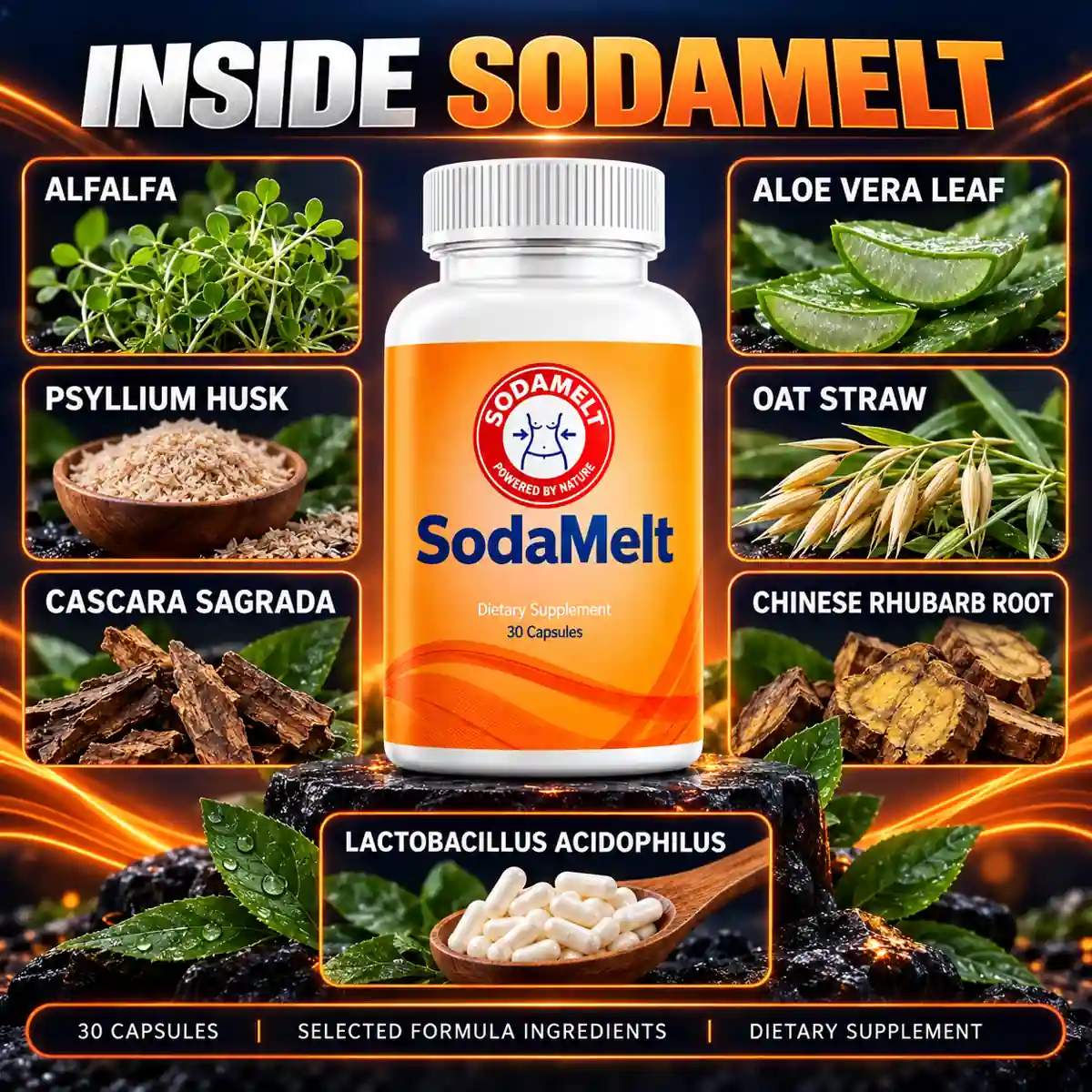
- Four of the eleven names inside the blend are anthranoid stimulant laxatives.
- That is how they work. It is established plant chemistry, not a claim about this manufacturer.
- No individual amount is printed for any of them, so how strong the effect is cannot be read off the bottle. 250 mg is the ceiling for all eleven together.
- The safety literature genuinely disagrees with itself, and both sides are set out here.
- A buyer choosing a gentle daily capsule and a buyer choosing a stimulant are making different decisions.
What an anthranoid actually is
Anthranoids, or hydroxyanthracene derivatives, are a family of compounds found in a handful of plants used as purgatives for as long as anyone has kept records. Senna is the most familiar member. Cascara, rhubarb root, buckthorn and the latex of the aloe leaf are the others that reach supplement panels.
The mechanism is direct. The compounds pass largely unabsorbed to the colon, where bacteria convert them to their active forms, and those act on the bowel wall to increase motility and secretion. The result arrives within hours, and it arrives whether or not anything else in the capsule has done anything.
Why that distinction matters on a supplement shelf
A bulk-forming fibre and a stimulant laxative both produce a bowel movement, and a buyer who feels one cannot tell which produced it. They are not equivalent, though. One works by holding water; the other works by acting on the colon. Knowing which is in the bottle is the difference between an informed purchase and a guess.
The four names on this panel
The label prints eleven botanicals inside the blend, each with a Latin binomial and a plant part. Four of those eleven belong to the family above.
| Name on the panel | Plant part | What the chemistry is |
|---|---|---|
| Cascara Sagrada | Rhamnus purshiana, bark | Hydroxyanthracene derivatives. A stimulant laxative with a long pharmacy history. |
| Chinese Rhubarb | Rheum palmatum, root | Anthraquinones including emodin. Purgative at higher amounts, astringent at lower ones. |
| Buckthorn | Rhamnus cathartica, bark | Anthraquinones with, in LactMed's phrase, potent cathartic properties. |
| Aloe Vera | Aloe barbadensis, leaf | The latex layer under the rind carries anthraquinones. The inner gel does not. |
Four of the eleven names inside the blend, read from the printed label artwork. The fourth is the one most readers assume is the soothing kind of aloe.
The LactMed entry on cascara sagrada and the entry on buckthorn are the plainest short descriptions of two of them, and the second uses the phrase potent cathartic properties without hedging it. EFSA's 2024 opinion covers rhubarb root and cascara bark by name alongside frangula bark, which is a close relative of the buckthorn on this panel.
The aloe row is the one that surprises people
Aloe has a gentle reputation, and that reputation is earned by a different part of the plant. The clear inner gel is the material in drinks, in skin preparations and in the controlled trials. The latex, a bitter yellow layer sitting just under the rind, is where the anthraquinones are.
This panel says leaf. A leaf preparation may include the latex, which is why the row belongs in this post rather than in a post about soothing botanicals. The distinction is handled at greater length in the ingredients page, which sets each name beside the research that does and does not apply to it.
Three practical readings follow:
- A panel that says aloe gel and a panel that says aloe leaf are describing different materials with different effects.
- The published aloe trials in digestive conditions used gel preparations, so they do not transfer to a leaf row.
- Aloe leaf on an ingredient list alongside cascara, rhubarb and buckthorn is a fourth member of the same family rather than a counterweight to them.
How much is in there, and why nobody can say
This is the part that cannot be resolved from outside the bottle. The panel prints 250 mg for the whole Proprietary Blend, with a footnote reading Daily Value not established, and no figure against any individual name.
So 250 mg is the ceiling for all four of these together as well as for the other seven. An even split across 11 names would be 22.7 mg each, which would be a small amount of any of them. A blend weighted towards the cathartics would be something else. The label does not distinguish between those two bottles, and neither can anybody reading it.
How strong the laxative effect of this capsule is. That is exactly the question a single shared milligram figure cannot answer, and it is why the post on blends sits alongside this one.
See what the SodaMelt panel prints before you decide
Two rows, 11 botanicals inside one of them, every name and plant part on the label. One capsule a day with a full glass of water, and 60 days from purchase to change your mind.
One bottle $89 · six bottles $294 · 60-day money-back guarantee
Order SodaMelt On The Official WebsiteOne capsule a day · 30 per bottle · lot SOD-26/GO-2953
The safety literature, both halves of it
It would be easy to write this section in one direction and leave a reader alarmed. It would also be dishonest, because the published position is genuinely contested and has moved in the last few years.
| The question | One body of work says | Another says |
|---|---|---|
| Are hydroxyanthracene derivatives safe in food? | EFSA's 2018 opinion treated them as genotoxic and carcinogenic absent data to the contrary, and could not advise a safe daily intake. | A 2024 critical review argues much of the harm literature is confounded by the populations studied. |
| Do stimulant laxatives damage the bowel with use? | The long-held clinical worry, and the reason many guidelines reserve them. | The same 2024 review finds the evidence for structural damage weak. |
| Do they work for chronic constipation? | Senna, from the same family, was graded A in an updated systematic review of over-the-counter therapies. | None of cascara, rhubarb or buckthorn appears in that graded list at all. |
| What about the pigmentation reported with long use? | Melanosis coli is well described with anthraquinone herbs and reverses on stopping. | Its relationship to anything more serious has been examined and is not established. |
Both columns are cited below. A page running only the left-hand one would be a hatchet job and would deserve to be disbelieved.
The 2018 EFSA opinion is the strictest reading available and it is not a fringe document. Whorwell's 2024 critical analysis is the most thorough push in the other direction and it is equally mainstream. Rao and Brenner's systematic review sits in between, grading senna highly for chronic constipation while never reaching cascara, rhubarb or buckthorn at all, because the trials are not there.
The melanosis coli literature is the most frequently misreported piece of this. The pigmentation is real, it is associated with prolonged anthraquinone use, and it reverses when the herb is stopped.
Why naming the mechanism matters to a buyer
None of the above makes these four ingredients unacceptable. Plenty of people use stimulant laxatives deliberately and sensibly. The problem is only ever the gap between what a product is and what a buyer thinks it is.
A formula sold as gentle, daily and non-habit-forming sets an expectation. A formula containing four anthranoid herbs sets a different one. When the same bottle does both, the panel is the document that settles it, and the panel names all four.
Four things a reader can do with that:
- Read the blend list before the sales copy, because the blend list is the part nobody wrote for persuasion.
- Treat the arrival of a bowel movement as evidence that something worked, not as evidence that a particular ingredient worked.
- Take the bottle to whoever prescribes for you if you use a diuretic, because potassium loss is the interaction that pairs with this family.
- Decide in advance how long you intend to take it, because occasional and daily are different propositions for a stimulant.
SodaMelt is a dietary supplement for adults of 18 and over. It is not a medicine, it is not FDA-approved, and it is not intended to diagnose, treat, cure or prevent any disease. The side effects page sets out the three named interactions on this panel, each with a human study behind it, and the label's own caution block is quoted there in full.
Four questions for any blend with these names in it
- Does the label or the seller anywhere describe these ingredients as stimulant laxatives?
- Is an amount printed for each one, or is there a single blend figure covering them all?
- Is the aloe row specified as gel or as leaf, and does the seller cite gel research for a leaf row?
- Does the product's own marketing language contradict its own ingredient list, and if so, which one would you rather trust?
On this bottle the answers run: no, one figure for eleven, leaf, and yes it does. The panel is the document that survives all four questions, and the supplement facts page reproduces it row by row.
References
- Younes M, Aggett P, Aguilar F, et al. Safety of hydroxyanthracene derivatives for use in food. EFSA J. 2018;16(1):e05090. PMID 32625659. https://pubmed.ncbi.nlm.nih.gov/32625659/
- Turck D, Bohn T, Castenmiller J, et al. Scientific Opinion on additional scientific data related to the safety of preparations of Rheum palmatum L., Rheum officinale Baill. and their hybrids, Rhamnus purshiana DC., Rhamnus frangula L. and Cassia senna L. EFSA J. 2024;22(5):e8766. PMID 38784839. https://pubmed.ncbi.nlm.nih.gov/38784839/
- Cascara Sagrada. Drugs and Lactation Database (LactMed). Bethesda (MD): National Institute of Child Health and Human Development; 2006-. Updated 17 May 2021. PMID 30000387. https://pubmed.ncbi.nlm.nih.gov/30000387/
- Buckthorn. Drugs and Lactation Database (LactMed). Bethesda (MD): National Institute of Child Health and Human Development; 2006-. Updated 21 June 2021. PMID 30000918. https://pubmed.ncbi.nlm.nih.gov/30000918/
- Rao SSC, Brenner DM. Efficacy and Safety of Over-the-Counter Therapies for Chronic Constipation: An Updated Systematic Review. Am J Gastroenterol. 2021;116(6):1156-1181. PMID 33767108. https://pubmed.ncbi.nlm.nih.gov/33767108/
- Whorwell P, Lange R, Scarpignato C. Review article: do stimulant laxatives damage the gut? A critical analysis of current knowledge. Ther Adv Gastroenterol. 2024;17:17562848241249664. PMID 38887508. https://pubmed.ncbi.nlm.nih.gov/38887508/
- Zhang R, Huang C, Wu F, et al. Review on melanosis coli and anthraquinone-containing traditional Chinese herbs that cause melanosis coli. Front Pharmacol. 2023;14:1160480. PMID 37214441. https://pubmed.ncbi.nlm.nih.gov/37214441/